

Hospitality hiring does not slow down. Turnover in leisure and hospitality averaged 70 to 80% annually through 2024, the highest rate of any sector tracked by the Bureau of Labor Statistics, and nearly 3 million people left hospitality roles in just the first four months of 2024 alone, more than double the national average quit rate. That is the volume you are working against every year, not as a crisis, just as the baseline.
The platforms below were evaluated specifically for how well they serve hotel and hourly hospitality hiring. Not general recruiting. The tools built for corporate tech hiring tend to look impressive until you try to fill fifty housekeeping roles before a peak weekend and the candidate profile takes ten minutes to load.
How we ranked these: features that matter for hospitality and hourly hiring, verified user reviews from G2, Capterra, and other sources, and honest fit for the operator actually doing this work.
1. HigherMe
HigherMe was built for exactly the type of hiring that breaks most general ATS tools: high-volume, hourly, multi-location, with a workforce that applies from their phones and disappears if the process takes more than five minutes. It covers job posting, applicant tracking, automated screening, interview scheduling, and onboarding in one place, designed for operators, not HR consultants.
The customer list tells the story. Hyatt, Hampton Inn, Palihouse, alongside QSR franchise brands like Domino's, Dunkin', and Tim Hortons. These are operations running real hiring volume every week. For hotel F&B, QSR-adjacent hospitality, and franchise operators, that is meaningful proof of fit at scale.
- Text-to-Apply via QR codes placed at your property gets candidates into the pipeline in under a minute from in-person materials. A housekeeper walks past a hiring sign in the staff entrance, sends a text, and their application is submitted before they reach the elevator. That is not a small thing in a sector where your best candidates are not browsing job boards at a desk.
- NextMatch AI pre-screens every applicant automatically. Structured interviews run without a manager present, candidates are scored by proximity to the property, availability match, and relevant experience, and a ranked shortlist lands in the manager's inbox before they've looked at a single raw application. For a hotel GM who is also managing guest complaints, vendor calls, and a full front-of-house operation, that automation is not a convenience. It is the difference between hiring this week and hiring next week.
- Onboarding lives inside the same platform. W-4, direct deposit, I-9, E-Verify, employee handbook: all completed before day one. No separate portal. No new hire arriving for their first shift to fill out paperwork that should have been done three days ago.
- The Hiring Hub gives multi-property operators centralized pipeline visibility across every location without separate logins. HigherMe holds an Indeed Platinum Partnership, giving listings 98% visibility on the platform.
Operators report an average time-to-hire of two days, 88% application completion rates, and a 67% reduction in interview no-shows from automated reminders. Setup is under 24 hours with no IT involvement.
What Users Say
Hiring managers say HigherMe cuts the back-and-forth out of scheduling and screening, particularly for multi-location teams. The phrase that comes up most across reviews is how quickly new managers get up to speed, with most reporting live job posts on the same day they onboard. The most common ask from existing users is more granular reporting at the individual location level. Read more here.
Best for: Hotel F&B teams, QSR-adjacent hospitality operators, multi-property franchise groups, and any hospitality business that hires hourly workers at volume without a dedicated recruiting team.
2. Harri
Harri is built specifically for the service industry, with hotels and restaurants making up most of their customer base. The platform covers hiring, onboarding, scheduling, and workforce management in one place, and the hospitality-focused candidate pool is a genuine advantage over general job boards. For enterprise hotel groups managing complex labor structures, the depth of what Harri covers in a single system is hard to replicate with separate tools.
The friction that comes up consistently in verified reviews is the mobile experience. The manager and employee apps have recurring bug reports, including login loops and missed push notifications, which matters a lot for a frontline workforce that lives on their phones. Pricing starts around $875 per month for roughly 100 employees, which also makes the evaluation harder for independent properties or smaller operators.
What Users Say
Across G2 and Capterra, the most cited praise is having everything in one place, specifically from GMs who came from multi-system setups. The friction point almost everyone mentions is the mobile app. Login issues and missed notifications are recurring themes, and for a workforce where the manager app is a daily operational tool, that is not a minor complaint.
Good for: Enterprise hotel groups and multi-unit restaurant brands with ongoing high-volume hiring who need workforce management depth in the same system as recruiting.
3. Workable
Workable is one of the most genuinely user-friendly ATS platforms available. It posts to 200-plus job boards in one click, has solid AI-assisted candidate sourcing, and its interview scheduling consistently gets praised for eliminating calendar back-and-forth. It is not hospitality-native, but it is flexible enough to work well for hotel operators who need a clean, fast recruiting engine without enterprise HCM complexity.
The honest limitation for hospitality operators is post-sale support. Several verified reviewers on G2 and Capterra note that account manager quality drops after the contract is signed, and the AI candidate scoring draws criticism for being imprecise at the kind of volume hospitality generates. The starting price of $189 per month is accessible for mid-size operations, but scalability issues show up at larger enterprise volume.
What Users Say
Reviewers consistently call Workable the easiest ATS they've onboarded a team onto. "Up and running same day" appears across multiple reviews. Where sentiment drops is post-sale: account manager responsiveness and AI scoring accuracy are the two most common frustrations, particularly for teams above 200 employees where the platform's performance starts to show cracks.
Good for: Mid-size hotel groups and independent properties that want a reliable, easy-to-manage ATS without paying for hospitality-specific modules they will not use.
4. Greenhouse
Greenhouse is consistently rated among the top enterprise ATS tools and earns that reputation for structured hiring. The analytics, customizable workflows, and DEI reporting are genuinely strong, and the structured interview kit and scorecard system reduces interviewer bias in ways that matter for management-level hiring.
For hourly hospitality roles, the fit breaks down at speed. Greenhouse's structure can slow high-volume hiring down rather than accelerate it. Some users report candidate profile loading times exceeding ten minutes, which is a real operational problem when you are trying to fill housekeeping and front desk roles before a peak season starts. The platform feels like it was designed for tech company hiring and adapted for hospitality rather than built for it.
What Users Say
Corporate and enterprise users describe Greenhouse as one of the better designed platforms they have worked with, especially for reducing interviewer bias through structured kits. In hospitality contexts the feedback divides sharply: teams using it for management roles are satisfied, while those applying it to high-volume frontline hiring find the workflow too rigid and the page load times too slow for practical daily use.
Good for: Corporate hotel chains with a dedicated TA team that values structured, data-informed hiring and has the headcount and time to justify the platform's complexity.
5. Hcareers
Hcareers has been around for over 25 years and remains one of the most targeted sourcing channels for hotel hiring in the US. The candidate pool is made up of people specifically looking for hospitality work, which reduces the noise that comes with generalist boards. It offers employer branding tools, resume database access, and AI-driven candidate matching on top of standard job listings.
The important caveat: Hcareers is not a full ATS. You will need a separate pipeline management tool alongside it. For entry-level or hard-to-fill hourly positions, the applicant volume is smaller than what you get from Indeed or ZipRecruiter. And the per-post pricing, starting at $249 per 30-day listing, is a real barrier for independent properties that hire occasionally.
What Users Say
Employers on Hotel Tech Report highlight a noticeably higher candidate quality-to-noise ratio compared to generalist boards, particularly for experienced hotel roles. The consistent trade-off in feedback is reach: for high-volume hourly positions, the pool is smaller than what broader platforms generate. Most operators use it as one channel in a multi-source strategy rather than a primary platform.
Good for: Hotels and resorts in the US looking for a targeted sourcing channel with a hospitality-committed candidate base. Works best as one part of a multi-channel strategy, not a standalone solution.
6. Hosco
Hosco is the closest thing to LinkedIn for hospitality. It has hospitality-specific candidate profiles and partnerships with hotel schools globally, making it a strong pipeline for early-career talent and international hires. Luxury hotel groups with multi-country properties will find it particularly useful because of the multilingual support and global candidate reach. It also offers a free employer profile and basic job posting, which makes it accessible for smaller properties that Hcareers pricing excludes.
Like Hcareers, Hosco is primarily a sourcing and employer branding platform, not a full ATS. The candidate community skews toward career-builders and hospitality school graduates rather than shift-takers. For filling front desk and housekeeping roles at volume, the reach is limited.
What Users Say
Employers using Hosco for graduate and early-career recruitment rate it highly for the quality of candidates coming out of hospitality school pipelines. The employer branding tools get specific praise, with hotel groups noting that the company profile pages attract candidates who actually understand the industry. The gap users consistently flag is operational hourly reach: Hosco's community is career-oriented, which is an asset for some roles and a mismatch for others.
Good for: International hotel brands and luxury properties looking to attract career-focused hospitality talent, including early-career candidates from hotel schools globally.
7. Wonolo
Wonolo is not an ATS. It is a same-day staffing marketplace that connects businesses with pre-vetted workers for immediate needs. For hotels dealing with a sudden call-out on a busy Friday, or event staffing for a banquet that just grew by forty covers, it fills a gap that no traditional hiring tool attempts to address. Workers are rated and reviewed after each shift, so you can build a bench of reliable people over time. The platform has filled over 3 million jobs and operates across 100-plus US cities.
The trade-off is cost and consistency. Wonolo is more expensive per hour than a full-time hire, and G2 reviews note that job availability varies significantly by market. In major metros the fill rate is strong. In smaller markets, it can go dry for stretches when you need it most.
What Users Say
Workers who use Wonolo regularly describe it as one of the more frictionless ways to pick up shifts. On the employer side, the feedback is more mixed: major metro businesses report good worker quality and fill rates, while operators in smaller markets flag availability gaps. Customer support responsiveness is the most consistent employer complaint, particularly when a shift goes wrong and resolution requires more than a chatbot.
Good for: Hotels and event venues needing fast, flexible labor for peak periods, last-minute gaps, or seasonal spikes. Should complement a permanent hiring platform, not replace one.
8. Lever
Lever has the best user interface of any ATS on this list. Recruiters consistently call it out as one of the few tools that does not feel like it was designed in 2005. The candidate-facing experience is clean, interview scheduling is smooth, and the talent relationship management feature is genuinely useful for building passive pipelines over time.
For hospitality, the fit problem is volume. Lever was optimized for hiring 20 to 100 people per year, not 20 per week. At high volume, the pricing becomes hard to justify: it starts at $12,000 per year, climbing quickly for larger teams. For corporate hotel chains with a small TA team filling management and corporate roles, it can make sense. For anyone trying to fill front desk, housekeeping, and F&B staff at scale, the math does not work.
What Users Say
Lever's G2 reviews are unusually consistent on the interface: recruiter after recruiter calls it the cleanest they have used. The frustration that surfaces most is the price-to-feature ratio at the base tier, with users feeling they are paying enterprise pricing for features that competitors include as standard. Base plan support is email-only, and response times are a recurring complaint from smaller accounts.
Good for: Well-funded hotel brands filling a low-to-medium volume of management and corporate roles where candidate experience and relationship management matter more than throughput.
9. Hospitality Online
Hospitality Online sits in an interesting middle ground. It is more than a job board because it includes applicant tracking, employer branding tools, and multi-property job distribution, but it is less comprehensive than a full HCM like Harri. For hotel management groups that want one place to post across all their properties, track applicants, and maintain a consistent employer brand without committing to enterprise pricing, it is a solid option. The company profile feature stands out: it lets candidates actually learn about a property before applying, which tends to improve application quality compared to bare-bones job listings.
The limitation most users flag is candidate volume. Hospitality Online's reach is smaller than generalist boards, so it works best as a supplementary channel rather than a primary one for high-volume hourly roles.
What Users Say
Hotel management group operators value it for centralized posting across properties and the company profile feature, which they say produces better-informed applicants than a generic job board. The consistent gap in feedback is volume: applicant quality is decent, but the pool is smaller than what broader platforms generate for hourly roles.
Good for: Hotel management companies operating multiple properties that need a hospitality-specific platform covering sourcing, employer branding, and basic applicant tracking in one place.
10. CoolWorks
CoolWorks is not for everyone, and that is the point. It connects employers at national parks, ski resorts, ranches, wilderness lodges, and destination properties with candidates who actively want to work in those places. These are not applicants scrolling through fifty listings. They are people specifically seeking work in a particular kind of environment, and that self-selection tends to produce meaningfully better retention than mass job board applications.
If your property sits in a remote or scenic location and you struggle to attract staff who will actually show up and stay through the season, CoolWorks reaches a candidate pool that nothing else on this list touches. Outside that context, the platform has almost no reach.
What Users Say
Resort and lodge operators report that CoolWorks candidates tend to ask better questions, arrive more prepared, and stay longer than those sourced from general boards. They attribute it to the intent-driven nature of the platform's audience. The honest limitation from employer feedback: outside seasonal and adventure-focused properties, the platform's reach effectively disappears.
Good for: Seasonal resorts, national park lodges, ski properties, and remote destination hotels that need candidates motivated by the location itself, not just the paycheck.
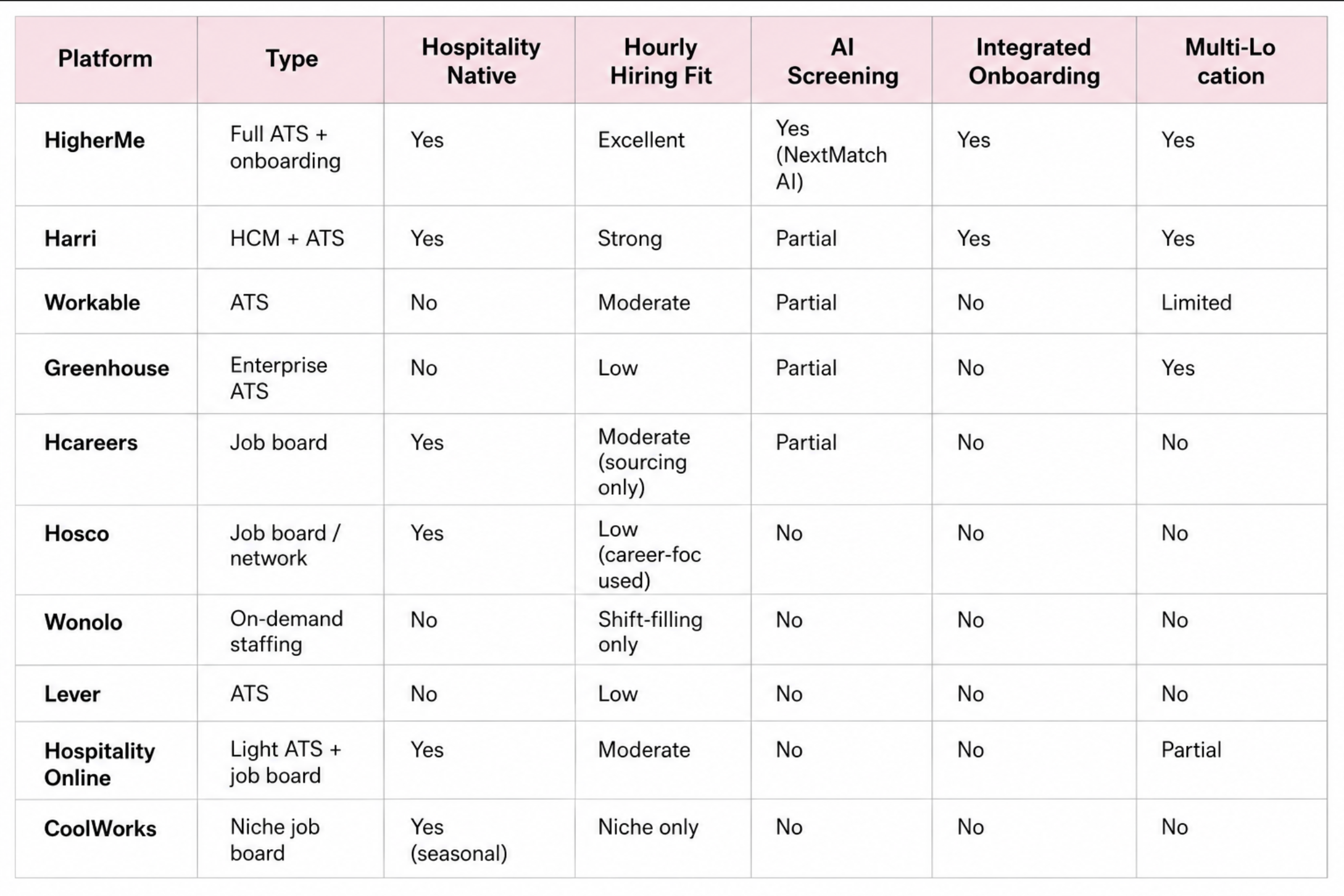
Quick Comparison Table
The Bottom Line
Every platform on this list does something well. Harri is genuinely impressive for large hotel groups that need scheduling and workforce management sitting next to their ATS. Greenhouse is one of the better-built recruiting tools on the market. Workable is fast, clean, and easy to justify to a finance team. Wonolo solves a problem no traditional ATS even tries to. And if you run a ski lodge in a remote location, CoolWorks is quietly irreplaceable.
But if you hire hourly in hospitality at any kind of volume, HigherMe is where to start. Not because the others are bad, but because most of them were built for a different kind of hiring and adapted to fit hospitality. HigherMe was built for this specific problem: high turnover, mobile applicants, multi-location operations, and managers already doing three other jobs simultaneously. The full hiring lifecycle from posting to onboarding in one place, designed for operators, not recruiters.
Visit higherme.com to see how it works for your operation.
Frequently Asked Questions
1. What is the best hiring platform for hotels and hospitality in 2026?
For hourly, high-volume hospitality hiring, HigherMe is the strongest fit. It was purpose-built for the operational reality of hotel and franchise hiring: mobile applicants, fast turnover, multi-location management, and onboarding that runs before day one. Harri is the better fit for large hotel groups who need scheduling and workforce management in the same system.
2. Is Harri or HigherMe better for hotel hiring?
Depends on the operation. Harri serves large enterprise hotel groups well when workforce management depth matters alongside hiring. HigherMe is better suited for operators who need fast, mobile-first hourly hiring without the HCM complexity, particularly for F&B, front desk, and housekeeping roles at volume. The mobile app bugs documented in Harri's reviews are also worth factoring in for a workforce that lives on their phones.
3. What is the difference between Hcareers and a full ATS for hospitality?
Hcareers is a sourcing tool, not a full ATS. It drives targeted applicants from a hospitality-specific candidate pool but does not manage the pipeline after they apply. You still need a separate platform for applicant tracking, screening, scheduling, and onboarding. Most operators use it alongside a full ATS rather than instead of one.
4. Do hospitality operators need a different kind of hiring software than other industries?
The case for it is strong. Most general ATS tools were built for structured office hiring, which assumes candidates have resumes, access to a desktop, and time to complete a multi-step application. Hospitality hourly candidates have none of those things. Platforms built specifically for hourly and mobile-first hiring, like HigherMe, produce meaningfully different results than adapted general tools.
5. What is CoolWorks and who is it actually for?
CoolWorks is a niche job board specifically for seasonal and destination properties: ski resorts, national park lodges, ranches, wilderness retreats. The candidate pool is made up of people actively seeking that kind of work, which drives better retention for those specific properties. Outside seasonal or adventure-focused contexts, it has essentially no reach and should not be treated as a general hospitality hiring tool.