
Ask any practice administrator at a multi-provider group what their most manual, error-prone process is, and it's rarely scheduling or billing. It's payroll. A hospitalist on production-based compensation, a PA on salary, a medical assistant on hourly with a weekend differential, a part-time billing coordinator whose hours need watching for ACA, all of that lands in one pay cycle, processed by one person who is already doing four other jobs.
Practice management platforms were designed for revenue cycle management. Payroll with five different compensation structures running simultaneously is a genuinely different problem, and most of them treat it as an afterthought.
What the 2026 Fee Schedule Changes Mean for Practice Payroll
The 2026 Medicare Physician Fee Schedule updates require real-time recalibration of physician compensation. For practices tied to value-based contracts, nightly batch processing is no longer workable, compensation changes have to flow through immediately. A platform that handles provider comp through manual workarounds turns every schedule change into retroactive correction work. For a practice administrator running lean, that's not sustainable.
The 5 Best Payroll Software Platforms for Physician Practices and Medical Groups
1. Netchex : Best Overall for Physician Practices and Medical Groups
What Netchex does differently for medical groups is handle the full range of compensation structures inside the payroll engine rather than forcing the practice to calculate the complicated ones manually alongside the system. Production-based provider compensation, salaried staff, hourly clinical support, per-diem coverage staff, all of it runs in the same payroll cycle with the correct rules applied to each. The practice administrator isn't maintaining a parallel spreadsheet to track what the system can't handle natively.
Credential and license tracking is built into the same platform processing payroll. For a group with multiple providers, this matters practically: an expired license that's tracked in a separate spreadsheet nobody checks consistently is a compliance gap waiting to happen. In Netchex, expiration alerts fire before a lapse rather than after someone has already been scheduled and paid through it.
Multi-site payroll gives administrators centralized visibility across all clinic locations from one dashboard. Staff working across sites are managed from a single employee record with location-specific rules applying automatically. ACA eligibility is monitored for part-time and per-diem clinical staff without manual tracking. After-hours and weekend shift differentials process without manual rate entry each cycle. The entire employee lifecycle, hiring through offboarding, runs under one login with HIPAA-compliant data handling throughout. Support picks up in under a minute from a U.S.-based team with healthcare experience. Thousands of physician practices and medical groups run on Netchex.
One verified G2 reviewer put it this way: "Netchex is easy to use and covers everything we need in one place. The support team is incredibly responsive and actually knows our account."
2. ADP Workforce Now : Good for Large Multi-Specialty Group Practices
There's a version of ADP Workforce Now that works well, it's the version where a large multi-specialty group with dozens of providers across multiple states has a dedicated HR team whose job is to own and configure the platform. Multi-state compliance is strong, the configurability is real, and the integration marketplace is broad. The version that doesn't work as well is the one where a small practice administrator is expected to configure clinical pay structures and credential workflows in a system that wasn't designed for either. Healthcare-specific features require setup work, and support routes through general tiers rather than anyone with clinical HR experience.
Good for: Large multi-specialty groups with dedicated HR staff and complex multi-state compensation requirements.
3. UKG Pro : Good for Medical Groups with Complex Scheduling
UKG made its name on scheduling and time management, and for medical groups running complex provider schedules across multiple clinic sites, extended hours, coverage rotations, multiple specialties, that depth is meaningful. The platform carries more weight than most growing practices need or want to absorb. Implementation is a real project with a real timeline, and ongoing management reflects the scale it was designed for.
Good for: Larger medical groups where managing complex provider scheduling across multiple sites is the primary operational challenge.
4. Paycor : Good for Growing Medical Groups
Paycor is a clean, modern platform that practice managers can navigate without a technical background, and it scales from a small single-site practice to a growing multi-location group without too much friction in between. Variable provider compensation gets configured during setup rather than working out of the box, so practices with production-based or collections-tied physician pay should factor that into their evaluation timeline. For groups with relatively straightforward comp structures that are primarily growing their site footprint, the platform covers the fundamentals reliably.
Good for: Growing medical groups adding clinic sites who want reliable multi-location payroll with a manageable learning curve.
5. Workday : Good for Large Integrated Medical Groups
Workday's analytics, workforce planning, and financial system integration are built for organizations where HR, finance, and clinical operations share data at enterprise scale. For large integrated medical groups that have grown to the point where those functions need to talk to each other across a complex organizational structure, Workday's depth becomes genuinely useful. For practices under 500 employees, the implementation investment and total cost of ownership relative to what mid-market platforms deliver make the decision fairly straightforward.
Good for: Large integrated medical groups with enterprise-scale complexity and dedicated HR, IT, and finance functions.
Quick Comparison Table
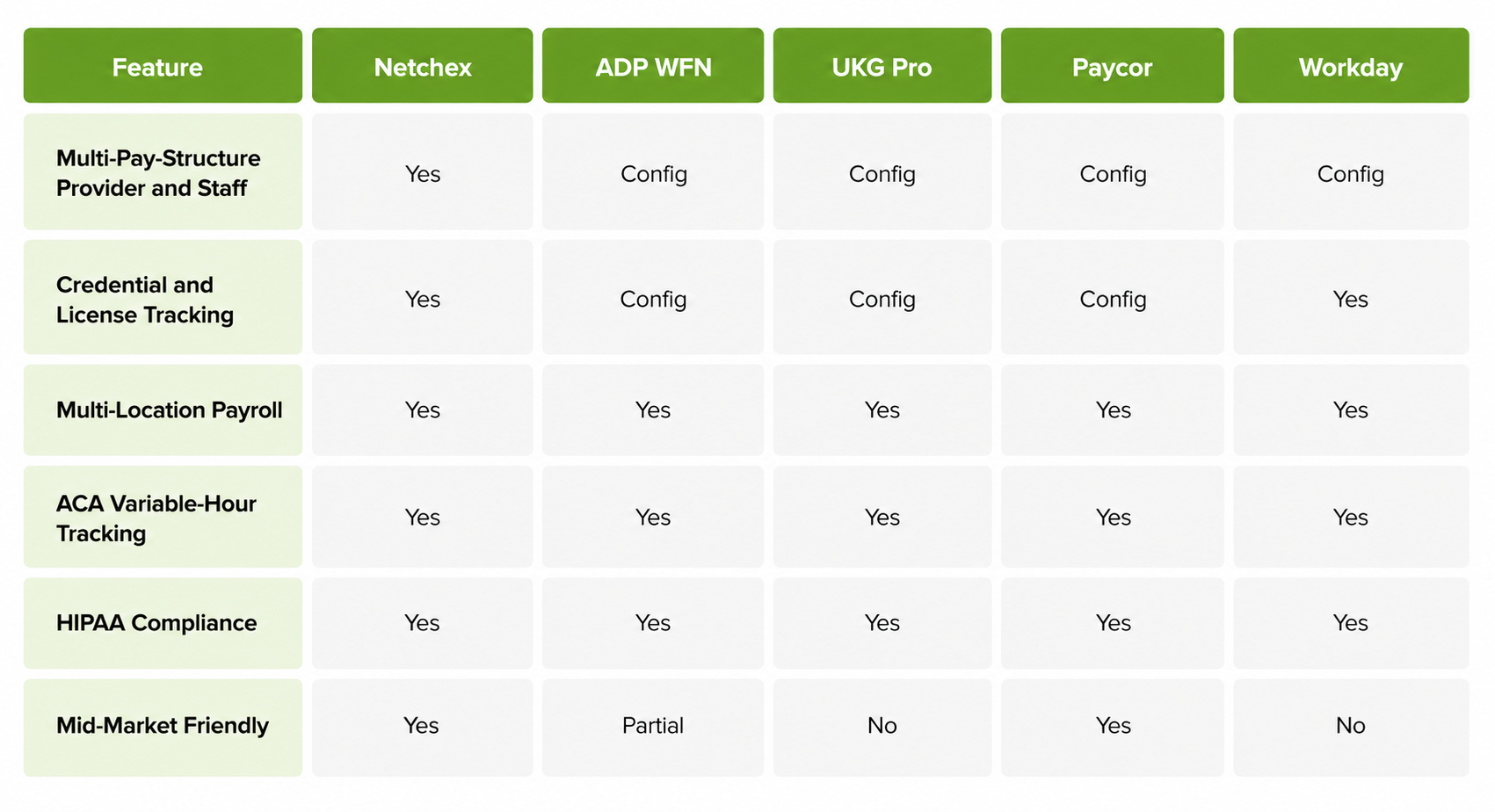
The Right Platform Makes the Practice Administrator's Job Manageable
Production comp, salary, hourly, per-diem, credential tracking, multi-site visibility, Netchex handles it all natively without requiring dedicated HR staff to keep it running. Request a demo at netchex.com.
Frequently Asked Questions
1. Production-based physician compensation and salaried staff in the same payroll run, how does that actually work?
Netchex holds multiple compensation structures natively within the same payroll run. Production-based, salaried, hourly, and per-diem all process with the correct rules applied to each. The practice administrator isn't managing separate workflows or a side spreadsheet to track what the system handles for them.
2. What does multi-site payroll management look like day-to-day for a group practice?
All clinic locations run from one dashboard. Staff shared across sites are on a single employee record with location-specific pay rules applying correctly wherever they work. Payroll processes for all sites in one run, and labor cost visibility across the whole group is centralized rather than stitched together from separate reports per location.
3. How does provider license tracking actually work, where does that data live?
Certifications and license expiration dates are stored inside the HCM platform alongside scheduling and payroll data. There's no separate spreadsheet, no manual cross-referencing before the schedule goes out. When a provider's license is approaching expiration, the system alerts you before it lapses rather than after you've already scheduled and paid through a compliance gap.
4. ACA compliance for part-time and per-diem clinical staff, what's actually automated?
Hours worked are tracked against ACA eligibility thresholds automatically for every variable-hour employee. When someone is trending toward coverage-required status, you see a flag before they cross the threshold. Medical practices with per-diem coverage staff and part-time clinical support are typically managing this manually on generic platforms, it's one of the first manual processes that goes away after switching.
5. Is Netchex practical for a smaller practice with 15 to 30 employees?
That's actually a size range where the single-platform model delivers a lot of visible value. It's designed to run without dedicated HR staff, implementation is guided by a Netchex team rather than configured independently by the practice, and support answers in under a minute. Smaller practices often discover after switching how much manual work they were absorbing that the right platform handles automatically.