
That's the core problem with route owner payroll. The people you're paying are in a vehicle, at a customer site, or somewhere along a delivery path, not near a shared terminal, not in an office, and definitely not filling out a paper timesheet that someone will decipher later. Most payroll software was designed around the assumption that employees go to a fixed workplace and clock in the same way every day. Route operations don't work like that, and the friction shows up in every pay cycle.
What Actually Makes Route Payroll Complex
It's not just the time tracking. Route-based businesses often run a mix of hourly, salaried, and performance-based pay, sometimes for the same driver on different days depending on what route they ran. Overtime exposure is real and not always obvious when route lengths vary. FLSA rules for route workers can be less straightforward than standard hourly, particularly when the same employee crosses different rate thresholds throughout the week. Onboarding needs to move fast because turnover in route-based work tends to run higher than operators expect, and a new driver sitting around waiting to get into the payroll system is a cost that adds up.
The 5 Best Payroll Software Platforms for Route Owners
1. Netchex : Best Overall for Route Owners
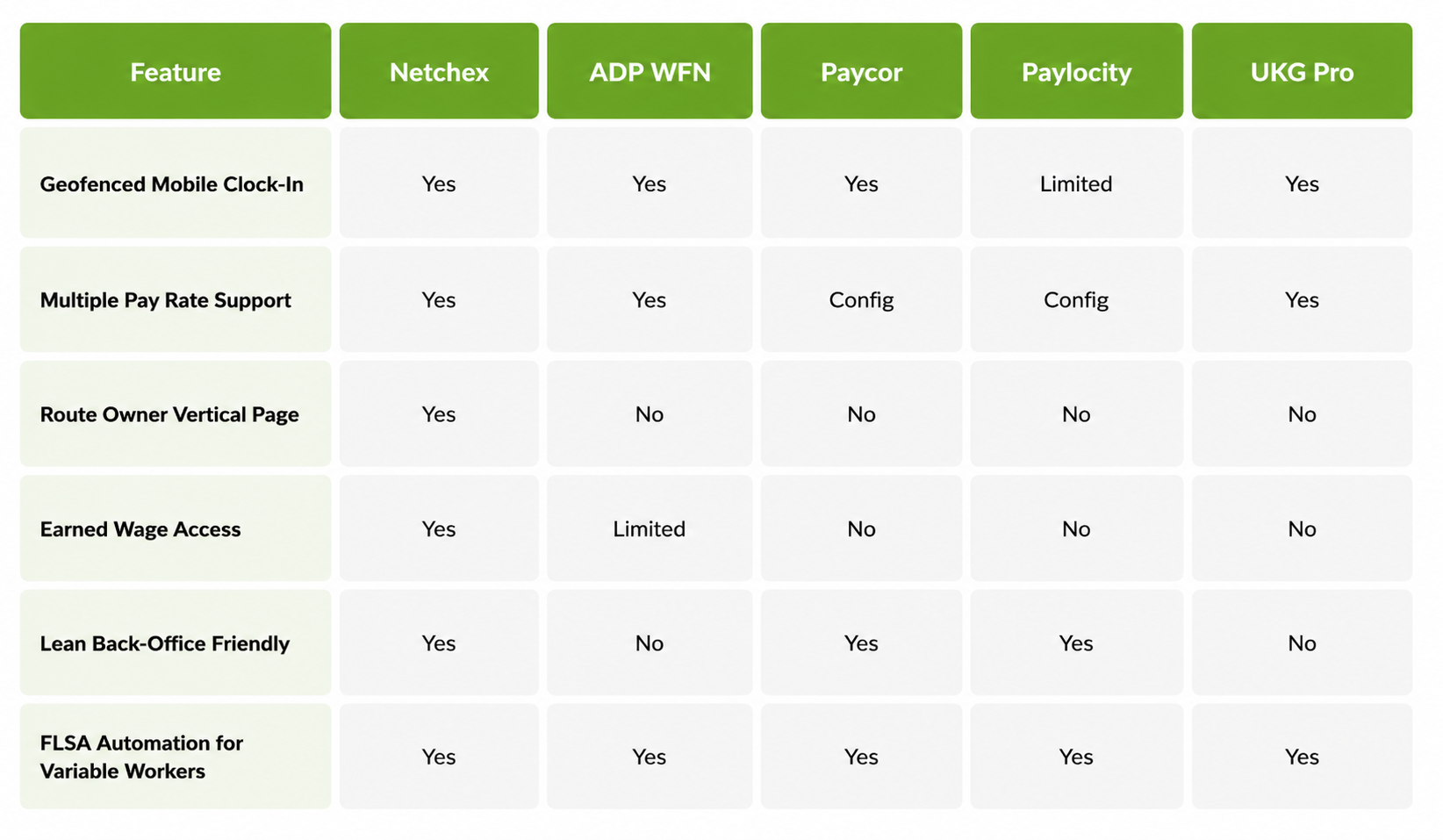
Netchex built a dedicated vertical for route owners specifically because distributed, deskless workforces need different infrastructure than office-based businesses. The practical result is a platform where the daily operational reality of route work,; drivers in different locations, variable routes, multiple pay rates, lean back-office staff, is accounted for rather than worked around.
Geofenced mobile clock-in is where time tracking starts. Drivers punch in from their phones and the punch is tied to their verified location at that moment. No shared terminal, no paper timesheet, no trying to reconstruct hours from handwritten logs at the end of the week. Multiple pay rate support means the same driver can work different route types or product lines on different days and get paid correctly for each without manual rate adjustments entering the picture. FLSA overtime tracking runs automatically, flagging exposure as it builds rather than surfacing it after a threshold has already been crossed.
Beyond time and pay, the full employee lifecycle runs in one place. New hires complete onboarding from their phones and are in the payroll system before their first run. Returning drivers reactivate in minutes because records carry forward. ACA eligibility is monitored automatically for variable-hour workers. Earned Wage Access gives drivers a way to access earned wages between pay cycles, which takes meaningful financial pressure off the people who are often working the longest hours. The back office handles everything from one dashboard rather than managing separate tools for time, payroll, onboarding, and compliance. Support picks up in under a minute from a U.S.-based team, and Netchex maintains a dedicated route owner industry page with resources specific to the vertical.
One verified G2 reviewer described it this way: "Netchex is easy to use and covers everything we need in one place. The support team is incredibly responsive and actually knows our account." (
2. ADP Workforce Now : Good for Large Distribution Route Operations
At enterprise scale, think a large distribution operation with hundreds of route workers across multiple states and a dedicated HR team, ADP Workforce Now's compliance infrastructure and configurability are genuine strengths. It handles multi-state tax complexity well and the breadth of its integration library is real. For a lean route owner running 15 to 30 drivers without dedicated HR staff, the complexity and cost are difficult to justify when simpler platforms cover the same ground.
Good for: Large distribution route operations with multi-state complexity and a dedicated HR team.
3. Paycor : Good for Growing Route-Based Companies
Paycor is a clean, modern platform that handles distributed workforce payroll at a mid-market scale without requiring a technical background to operate. Compliance tools are solid and it scales as operations grow. There's no route-specific vertical and no route management system integrations, so the operations-to-payroll data bridge stays manual. For a growing route business that hasn't yet hit those walls, it covers the fundamentals well.
Good for: Growing route-based companies who need reliable multi-location payroll before they need route-specific depth.
4. Paylocity : Good for Route Operator Engagement
Running a distributed workforce where employees spend most of the day alone in a vehicle creates a specific culture challenge: people disengage quietly before they leave. Paylocity's communication and recognition tools address that directly, peer shoutouts, manager check-ins, community feeds. Core payroll is solid. Mobile clock-in doesn't include the same geofencing depth as platforms built specifically for field workers, so time tracking accuracy in a distributed operation is worth evaluating carefully before committing.
Good for: Route operators focused on keeping a distributed workforce connected and reducing quiet voluntary turnover.
5. UKG Pro : Good for Large, Complex Route Operations
UKG's scheduling and time management depth is a genuine advantage for large route operations with complex rules, multiple product lines, and significant headcount where workforce management is its own operational challenge. The implementation investment and platform complexity make it the wrong fit for most independent route owners, who are running lean and need something they can operate without a dedicated team.
Good for: Large, complex route operations with dedicated HR staff and multi-state compliance requirements.
Quick Comparison Table
Payroll Built for an Office Doesn't Work on a Route
Your drivers aren't near a terminal. Their pay structures don't all look the same. Their overtime exposure builds on the road rather than at a desk. Netchex was built around that reality rather than retrofitted for it. Request a demo at netchex.com.
Frequently Asked Questions
1. Clock-in for a driver who's at a different customer stop every day,; how does that work?
Netchex's geofenced mobile clock-in verifies location at the moment of the punch via the driver's phone. Each punch record reflects where they were when they clocked in, without requiring a shared terminal or a manual timesheet. At the end of the week, hours are already clean and tied to verified locations rather than handwritten logs someone has to interpret.
2. What happens when the same driver runs different routes with different pay rates in the same week?
Netchex holds multiple pay rates within a single employee record and applies the correct rate to each day or shift automatically. No manual rate adjustments, no correcting entries after the fact. The driver gets paid correctly for every route type they ran without anyone having to calculate it separately.
3. FLSA overtime for route workers; isn't that just standard overtime rules?
Not always. Depending on route structure, product type, and state, the overtime calculation for route workers can get more complicated than standard hourly overtime. Netchex automates the tracking and flags threshold crossings as they accumulate, which matters particularly when one driver runs multiple routes in a week and the hours stack differently than a fixed-schedule employee.
4. What does Earned Wage Access mean for a route driver practically?
If a driver has a bill due Thursday and payday is Friday, Earned Wage Access lets them pull what they've already earned without waiting. For people working physically demanding jobs and often living closer to the financial margin, that flexibility matters. Netchex includes it as a built-in feature rather than an extra cost.
5. Is Netchex practical for a smaller route operation, say, 10 to 15 drivers?
That's actually the operator profile Netchex was built for in this vertical. The platform is designed to run without dedicated HR staff, implementation is guided by a Netchex team rather than handled by the operator, and support answers in under a minute when something comes up. Small route operations tend to get more out of the one-platform model than larger ones with more internal resources.