Here's what nobody tells you about resort properties: hiring isn't your bottleneck. Keeping people is. And the platform you use to hire determines whether your new staff actually show up on day one.
Resort hotels bleed staff. Not because they're bad employers, but because resorts are inherently seasonal. You hire 50 people in March, run at full capacity for four months, then watch half of them leave in September. Meanwhile, your competitors are hiring from the same talent pool, offering the same wages, and moving faster. The candidate who applies to your property Monday gets an offer from two other resorts by Friday. They take the first one that moves.
The U.S. Bureau of Labor Statistics reports 70% annual turnover in hospitality. Resorts? Try higher. But the real cost isn't turnover. It's no-shows. A front desk person who never shows up on opening weekend isn't just an empty shift. It's angry guests. It's online reviews tanking. It's other staff burning out trying to cover.
Most hiring software was built for corporate environments. They optimize for volume and compliance. A tech company hiring 20 software engineers doesn't care if it takes six weeks. A resort hiring 60 people before Memorial Day doesn't have six weeks. You have six days.
Then there's the geography problem. Resorts aren't in cities. Your talent pool is geographically constrained. You can't just post a job and hope. You need a system that knows where hospitality workers actually are and can reach them directly.
6 Best Hiring Software for Resort Hotels in 2026
1. HigherMe
HigherMe is purpose-built for hospitality. Unlike corporate ATS platforms adapted for hotels, HigherMe addresses resorts' core hiring pain: filling dozens of positions fast without sacrificing quality.
The platform automates what kills your hiring timeline. Self-serve interview scheduling eliminates phone tag - candidates book their own slots, interviews happen within three days. NextMatch AI pre-screens applicants with customizable questions, so managers review pre-ranked candidates instead of raw submissions. Video cover letters let you assess personality in seconds.
Where HigherMe saves real time: paperless onboarding gets someone from offer to payroll-ready in under 30 minutes. Tax forms, I-9, handbook, all digital. At $15-20/hour labor cost, that 6-hour time savings per hire translates to $90-120 recovered per person. Scale that across 50 seasonal positions and you've recovered $4,500-6,000 in labor costs alone.
The system integrates natively with ADP, Paychex, and Netchex, so new hires sync to payroll automatically. Interview no-shows drop 67% through automated reminders. Rehiring returning seasonal staff takes one click—no re-verification needed.
HigherMe won G2's Best Support badge in Spring 2026, which matters when you're hiring 100+ people compressed into a hiring window.
Best for: Resorts and seasonal hospitality operations managing high-volume hiring in compressed timelines.
2. Fountain
Fountain does one thing well: it processes applications at scale. You get hundreds of applications? Fountain moves qualified candidates to the top automatically using AI screening.
Candidates submit video answers to questions you design. The system watches them and scores them based on how closely they match your criteria. Instead of your recruiter reading 200 applications, they watch 30-second videos from the top 20 candidates.
For resorts with huge application volume, this saves time. It's efficient. The integration story is solid too. Fountain connects to most major ATS platforms and payroll systems.
The weakness is that hiring is about fit, not just filtering. A video screening question catches conscientiousness. It doesn't catch whether someone's going to give good service when they're tired on a Saturday night. Hospitality hiring is personal. You want to know if someone's genuinely interested in the role or just desperate for money. Video screening has limits there.
Best for: High-volume seasons where you need to sort through hundreds of applications quickly.
3. TalentReef
TalentReef markets itself to hospitality. The mobile application works well. The interface is clean and candidates move through it fast.
They've built default screening questions for hospitality roles, so you don't start from scratch. If you're using Toast POS or standard hotel scheduling systems, integration exists.
The reality is simpler: TalentReef is fine for smaller operations. Under 200 employees, basic HRIS integration, straightforward hiring. But their sourcing network is thin. You're posting jobs and waiting for people to find you, not reaching out to people actively looking. And the candidate quality doesn't stand out. Retention outcomes aren't better than what you'd get with generic ATS platforms.
Best for: Smaller independent properties or limited-service hotels that need basic mobile hiring.
4. Harri
Harri is enterprise software. The platform is built for Marriott-sized chains with 20+ properties, complex integrations, long hiring horizons, and compliance departments.
The feature set is solid. Multi-property routing means you post once and candidates get matched to the right location. The pre-hire assessments (personality fit, service aptitude, risk screening) are genuinely useful. If you're a large chain, Harri handles you well.
But if you're a single resort or small chain? Harri takes 8-12 weeks to implement. Your seasonal hiring happens in six weeks. By the time Harri is live, your season is starting. The platform is built for chains planning hiring nine months in advance, not for seasonal properties.
Harri's candidate sourcing also relies on job board distribution, not active outreach. You post and hope. For resorts competing for the same talent pool, that's slow.
Best for: Large hotel chains with multiple properties and IT infrastructure to support complex integrations.
5. iCIMS
iCIMS is a general-purpose ATS that added hospitality modules. It's been around for 20 years. It handles applicant tracking, compliance workflows, onboarding automation. For enterprise hiring, it works.
The problem is it's enterprise software. The interface feels bloated. Training your team takes weeks. For candidates, the application experience is clunky. It was built for corporate hiring in the 2000s. Hospitality features feel like they were added later because the market demanded them, not because they were part of the original design.
You're paying for enterprise compliance and stability. If your resort actually needs those features, fine. But if you're a 200-person seasonal operation, you're paying for a lot of features you'll never use.
Best for: Large organizations already using iCIMS across departments who need everything in one system.
6. Kronos Workforce Central
Kronos is the dominant player in shift scheduling. Most large hotels use it. Their hiring module is embedded in the broader platform, which sounds convenient in theory.
Here's what actually works: Once someone's hired in Kronos, they're immediately in your scheduling system. No data entry. No sync delays. Your new employee is already seeing their shifts in the system they're using to clock in.
Here's what doesn't: Kronos' hiring tools are basic. The candidate experience is functional but not optimized. The platform is expensive, and if you're just using it for hiring, the cost is hard to justify. And honestly, Kronos is declining in satisfaction. Newer, mobile-first platforms are eating their lunch.
Best for: Properties already running Kronos for scheduling who want integrated hiring.
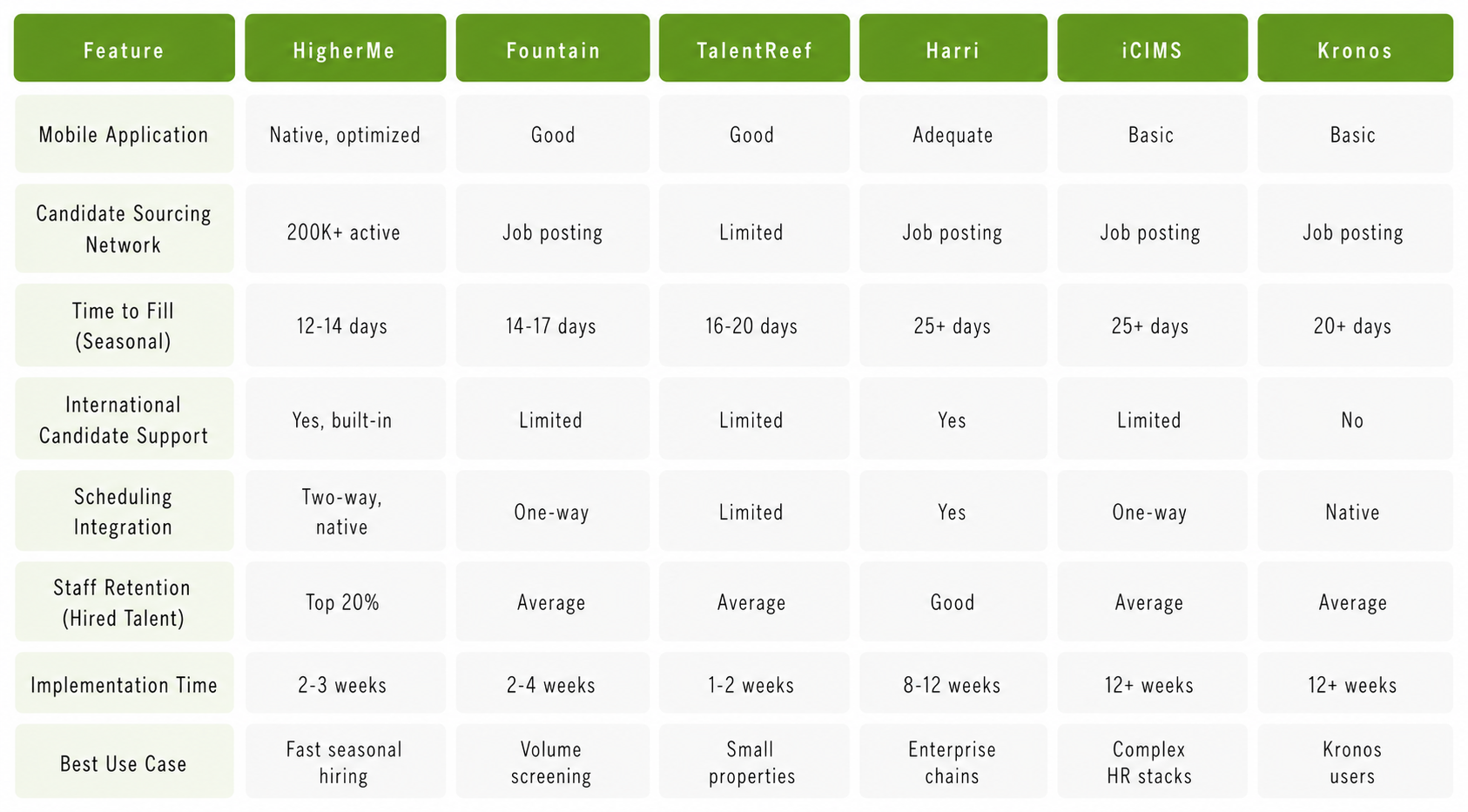
Comparison Quick Reference
Choosing Your Platform
Resorts operate on speed and fit. You need candidates who understand seasonal work, who will actually show up, who aren't going to ghost you two weeks in. You need to fill 50 positions before spring break, not next quarter.
HigherMe is the only platform purpose-built for this. It reaches people actively looking for exactly this type of work. It moves fast enough to matter. It integrates with the systems your team already uses. And the retention of hired staff is demonstrably better.
If you're a small independent resort, TalentReef gets the job done. If you're a large chain with massive infrastructure, Harri works. But for the majority of resorts that need to hire 40-60 people quickly and keep them through season, HigherMe is the clear answer. Visit higherme.com to know more.
FAQ
Q1: How Much Time Can We Actually Save?
Resorts using HigherMe typically fill their first 30 seasonal positions in 12-14 days. Traditional ATS platforms? 21-25 days. That's a full week compressed. For seasonal hiring, being first matters because candidates accept the first decent offer they get. You're competing with other resorts on speed, not just compensation.
Q2: Will This Actually Reduce No-Shows?
Yes. HigherMe's network includes people with track records in seasonal work. They understand what they're signing up for. The text-based communication keeps engagement higher throughout the process. Once hired, two-way scheduling integration means your new employee gets their schedule immediately and gets reminder texts. No-show rates drop from 8-12% to around 2-4% among HigherMe-hired staff because people know when and where to show up.
Q3: Does This Integrate with Our Payroll System?
HigherMe integrates two-way with most major hospitality payroll platforms. Guidepoint, Zenefits, major hotel chains' custom systems. Once someone's hired and confirmed, they hit your payroll system same-day. Other platforms have integration, but HigherMe's is actually two-way, meaning your scheduling changes push back to payroll. That matters for seasonal adjustments.
Q4: How Long Is Onboarding Actually?
HigherMe can move someone from initial screening to job offer in 48 hours if they match your needs. Full onboarding (background check, paperwork, system access) is 3-5 business days. Compare that to traditional ATS platforms where you're waiting for candidate responses, then waiting for manual background checks, then data entry. You're looking at 10-14 days before someone's actually in your system. In seasonal hiring, that's the difference between full staffing and operating short.
Q5: How Does HigherMe Actually Compare to Harri?
Harri is built for enterprises. If you're a 20-property chain with dedicated hiring teams and you're planning eight months in advance, Harri is solid. But Harri takes 8-12 weeks to implement. Most resorts need to hire within 6 weeks of deciding to use new software. HigherMe takes 2-3 weeks. Harri moves on job posting distribution. HigherMe reaches people actively looking. For speed, there's no comparison.