
A single pay period at a regional hospital might involve shift differentials for RNs that vary by unit and time of day, on-call activation fees for physicians, overnight and weekend premiums, multiple pay rates for staff working across departments, union wage scales, ACA eligibility tracking for PRN nurses who pick up extra shifts, CMS staffing compliance reporting, and payroll running across the main campus and two affiliated clinics simultaneously.
Most software handles parts of that. The administrative burden at hospitals that can't find something handling all of it shows up as manual reconciliation work, payroll corrections after the fact, and compliance exposure that builds quietly.
The Market Is Growing Because the Problem Is Getting Harder
The payroll software market in healthcare is projected to grow from $1.12 billion in 2025 to $2.10 billion by 2031 at an 11 percent CAGR. Hospitals and health systems are a significant driver. The 2024 Change Healthcare breach raised data security standards across the sector. The 2026 Medicare Physician Fee Schedule update requires real-time compensation recalibration that batch-processing systems can't deliver. The platforms that were adequate five years ago aren't adequate now, and health systems are making platform decisions that reflect it.
The 6 Best Payroll Software Platforms for Hospitals and Health Systems
1. Netchex : Best Overall for Mid-Market Hospitals and Health Systems
Netchex's healthcare vertical was built for the operational reality of regional hospitals and health systems where clinical pay complexity, multi-entity management, and compliance depth matter more than generic feature breadth. The platform covers the full employee lifecycle under one login: hiring, onboarding, time, payroll, benefits, performance, compliance training, and engagement, which reduces the administrative overhead for clinical HR teams that don't have the bandwidth to manage five separate systems.
The scheduling-to-payroll connection is where the practical value is most visible. Shift differentials in a hospital aren't a single rule, they vary by unit, by role, by time of day, by whether the shift was on-call or scheduled, and sometimes by facility. A platform where scheduling and payroll share the same data layer processes those rules automatically every cycle without a manual reconciliation step between the two. On-call activation pay, overnight premiums, and specialty differentials apply based on what the schedule shows rather than what someone remembered to enter.
Multi-entity payroll management handles employees shared across hospital campuses and affiliated clinics with consistent pay rules and centralized compliance visibility from one dashboard. Credential and license tracking sits inside the HCM platform alongside scheduling data, expiration alerts fire before a lapse rather than after. PRN and part-time staff ACA eligibility is tracked automatically, which for most hospitals is a significant portion of the clinical workforce. Earned Wage Access is available for frontline clinical and support staff, and research consistently links it to lower voluntary turnover among hourly healthcare workers. Data handling is HIPAA-compliant. Support picks up in under a minute from a U.S.-based team with healthcare experience.
For a mid-market health system running 200 to 1,500 employees across multiple facilities, that's enterprise-grade compliance depth without the implementation timeline and total cost of ownership of platforms built for 10,000-employee systems.
One verified G2 reviewer described the experience: "Netchex is easy to use and covers everything we need in one place. The support team is incredibly responsive and actually knows our account. It's a huge step up from what we had before."
2. ADP Workforce Now : Good for Large Multi-State Hospital Systems
For large multi-state hospital systems with dedicated HR, IT, and compliance staff, ADP Workforce Now's depth in compliance infrastructure and configurability is real. Multi-state tax handling is solid and the integration marketplace is broad. The consistent friction points for mid-market hospitals, a complex interface, long implementation timelines, support that routes through general tiers rather than healthcare-experienced staff, are manageable at scale with the right internal resources. Without them, those friction points become daily operational problems.
Good for: Large multi-state hospital systems with dedicated HR, IT, and compliance staff.
3. UKG Pro : Good for Complex Union and Scheduling Environments
UKG's workforce management tools, union rules, shift rotation, complex scheduling patterns across multiple units, are the strongest on this list for hospitals where workforce scheduling is its own operational discipline. If significant union contracts with detailed scheduling rules are driving your platform decision, UKG earns serious consideration. Implementation is a major project and the platform requires dedicated HR and IT staff to operate and maintain. It's the wrong fit for community hospitals and smaller health systems without those internal resources.
Good for: Large hospitals with significant union agreements where scheduling and workforce management complexity are the primary HR challenges.
4. Workday : Good for Large Integrated Health Systems
Workday's analytics, financial integration, and workforce planning become genuinely powerful at the level of a large integrated health system where HR, finance, and clinical operations share data across a complex enterprise. For community hospitals and regional systems under roughly 2,000 employees, the implementation investment and total cost of ownership are difficult to justify when mid-market platforms cover the same functional ground at a fraction of the cost.
Good for: Large integrated health systems with complex multi-entity financials and a full internal HR, IT, and finance function.
5. Paycor : Good for Growing Regional Health Systems
Paycor handles multi-location healthcare payroll with a modern interface that doesn't require a technical background to operate. Regional health systems adding facilities will find it scales without too much friction. Credential tracking and clinical pay structures need to be configured during setup rather than working natively, worth factoring in when evaluating implementation timelines.
Good for: Growing regional health systems adding facilities who want reliable multi-location payroll with a manageable learning curve.
6. Paylocity : Good for Hospital Employee Engagement and Retention
Paylocity's recognition, communication, and survey tools address the culture and retention side of the hospital workforce challenge in a way that standard payroll platforms don't. In a high-turnover clinical environment where staff feel disconnected, those tools move numbers. Core payroll is reliable. There's no native clinical pay structure depth for hospitals with complex differential and on-call pay requirements, so it addresses the culture problem more than the payroll complexity problem.
Good for: Hospitals focused on building staff culture and improving voluntary retention alongside standard payroll management.
Quick Comparison Table
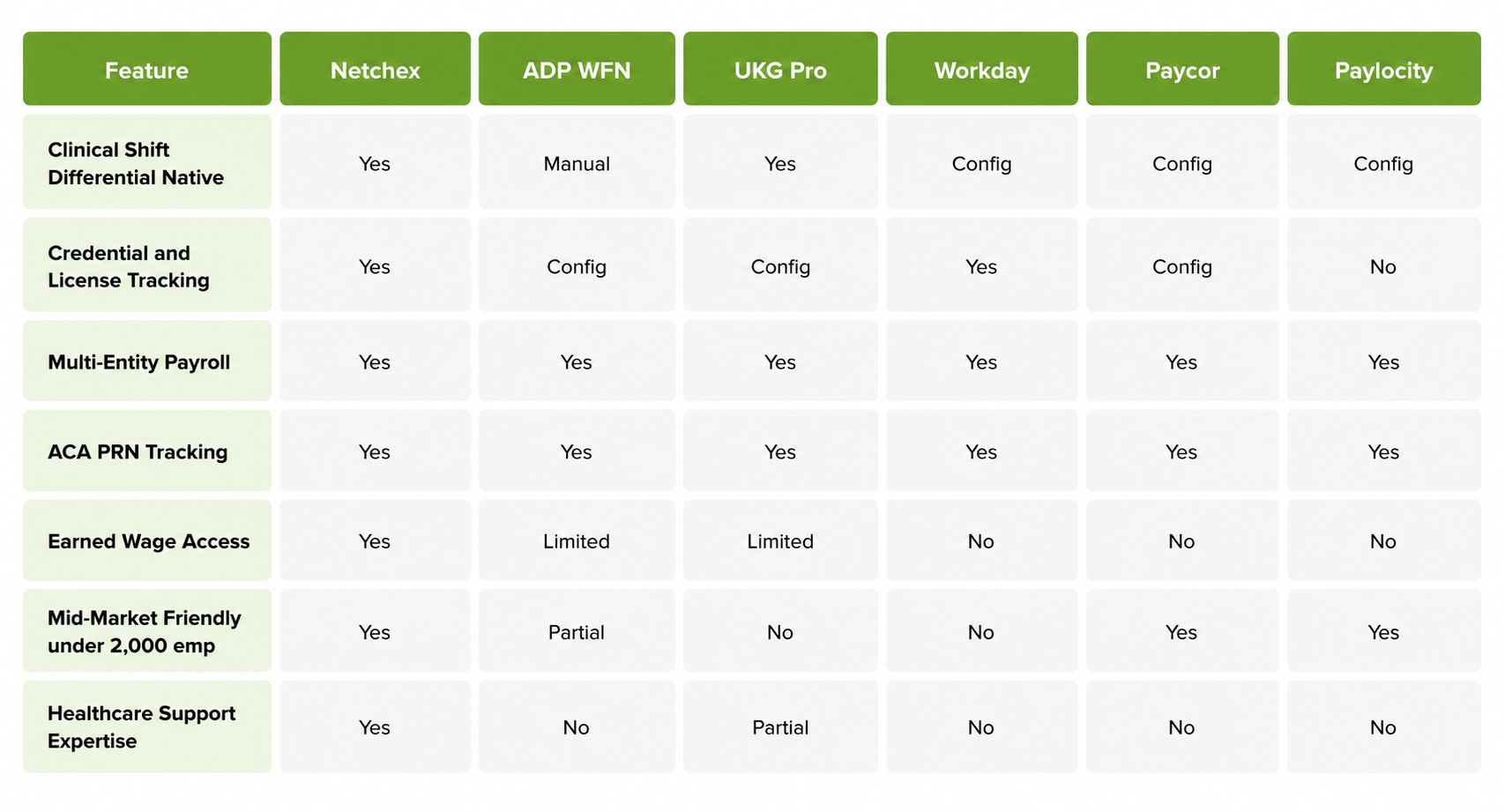
Hospital Payroll Complexity Needs Infrastructure That Was Built for It
Generic platforms are not designed to manage the clinical pay complexity of regional hospitals and mid-market health systems. Netchex does it all natively – differentials, multi-entity payroll, credential tracking, PRN compliance, and has a support team that really gets healthcare. [Request a demo at netchex.com]. Request a demo at netchex.com.
Frequently Asked Questions
1. On-call activation pay and shift differentials, how does Netchex actually process those?
Both are handled natively inside the payroll engine based on scheduling data. On-call activation pay applies when the schedule shows it. Shift differentials for nights, weekends, holidays, and specialty units process automatically with the correct rule for that employee's role and unit. There's no manual re-entry step and no reconciliation between the schedule and payroll after the fact.
2. What does multi-entity payroll management actually look like across hospital campuses?
Employees shared across the main campus and affiliated clinics are managed from a single record in Netchex. Pay rules apply correctly regardless of which facility they worked at. Payroll processes across all entities from one dashboard, and compliance visibility is centralized rather than managed separately per campus.
3. PRN nurses who pick up shifts inconsistently, how does ACA compliance work for them?
Netchex tracks every hour worked against ACA eligibility thresholds for all variable-hour PRN staff automatically. When someone is trending toward coverage-required status, you get a flag before they cross the threshold rather than discovering a compliance exposure after it's already been triggered. Hospitals with large PRN workforces typically find manual ACA monitoring is one of the first things they stop doing after switching to Netchex.
4. Is Netchex the right size for a community hospital with 300 to 600 employees?
That's actually the size range where Netchex tends to deliver the most visible value. It provides enterprise-grade healthcare compliance depth without the implementation timeline and cost of platforms designed for 10,000-employee systems. Community hospitals typically don't have the internal IT and HR staff to absorb a heavy enterprise implementation, Netchex is built to run without that.