
On the surface it looks straightforward, teachers on salary, staff on hourly. But then you get into the actual mechanics of a district payroll cycle. Certified teachers on ten-month annualized pay distributed across twelve months. Classified support staff on hourly with overtime exposure. Substitutes who might work two days one week and eight the next. Food service workers, maintenance crews, and bus drivers each operating under different pay rules. An FMLA request that needs leave balances tracked across state-specific policy. A paraprofessional whose variable hours are quietly approaching an ACA eligibility threshold.
Generic payroll software tends to handle one or two of those structures cleanly and force the district to figure out the rest manually. That manual figuring-out is where errors accumulate.
Low Turnover Doesn't Mean Low Complexity
Education sees among the lowest voluntary turnover of any industry, around 1.4 to 1.8 percent monthly. Workforce stability is a genuine strength for school districts. What it doesn't reduce is the structural complexity of paying a workforce that includes six different employee categories under six different pay frameworks in the same cycle. Netchex serves K-12 education as a declared vertical with infrastructure specifically designed for how schools and districts pay their people.
The 6 Best Payroll Software Platforms for Schools, School Districts, and K-12 Education
1. Netchex : Best Overall for K-12 Schools and School Districts
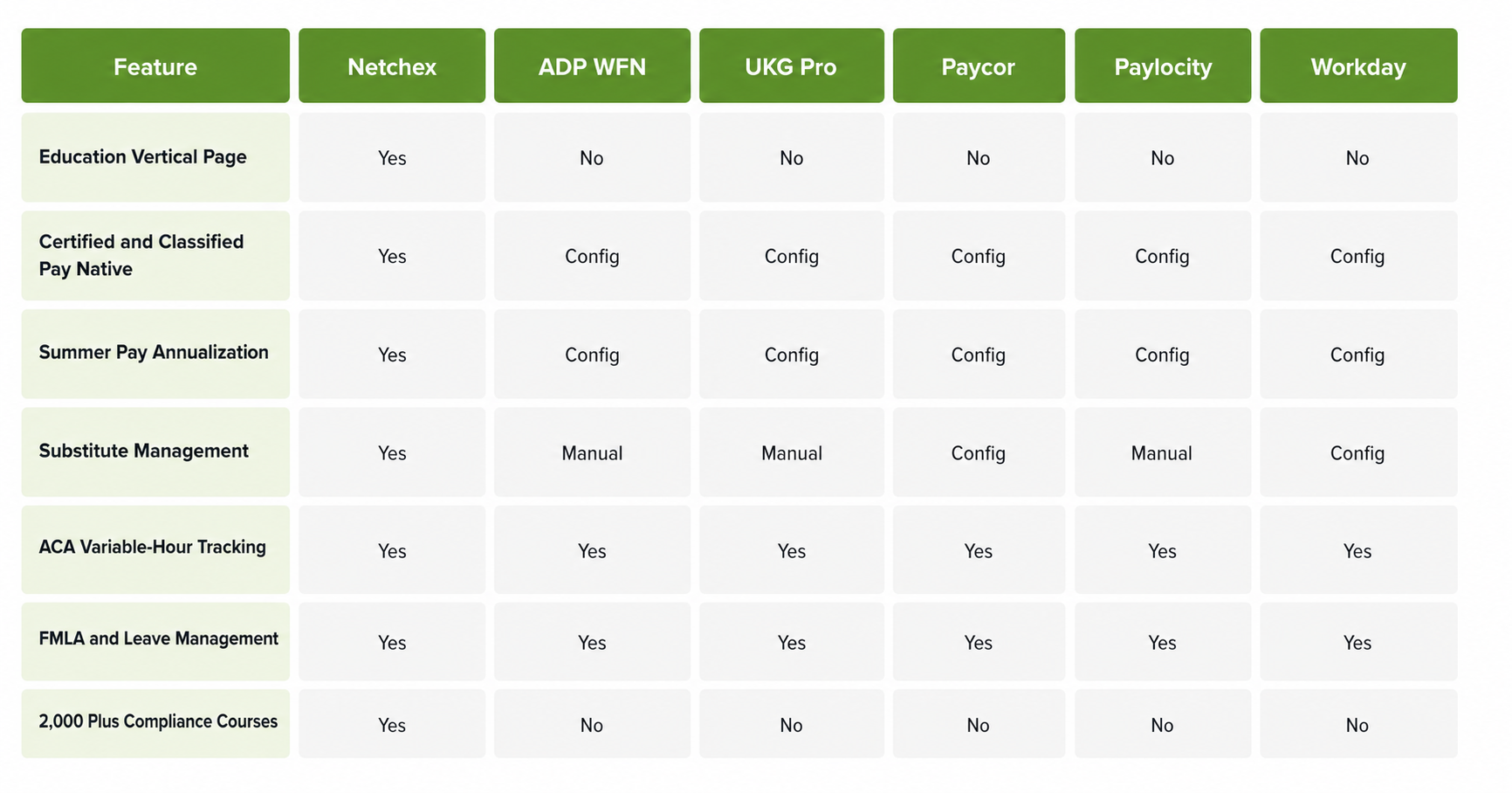
What Netchex built for K-12 education is a platform where the structures that define school district payroll: certified vs. classified pay, summer annualization, substitute management, FMLA tracking, are native to the system rather than configured workarounds that someone has to maintain and update manually.
Certified salaried teachers and hourly classified employees run in the same payroll cycle with the correct rules applied to each automatically. Substitute teachers with variable daily pay are tracked inside the platform without a parallel spreadsheet alongside it. Summer pay scheduling and annualization options let districts handle teacher compensation across the school calendar the way they actually want to rather than treating July as a payroll exception someone has to resolve manually.
FMLA and state-specific leave management is built into the HR module, leave balances, eligibility, and return-to-work documentation are tracked automatically rather than maintained in a separate system. ACA eligibility runs automatically for variable-hour paraprofessionals, food service, and support staff, which is the segment most districts are monitoring manually when they're on the wrong platform. Paperless onboarding from any device means substitutes and new hires complete documents before their first day without an in-person HR appointment.
The compliance layer is particularly relevant for districts receiving federal Title I or Title II funding, where payroll records need accuracy and auditability that standard platforms don't reliably provide. Over 2,000 compliance and professional development courses in English and Spanish are built into the platform. The full employee lifecycle runs under one login. Support answers in under a minute from a U.S.-based team.
One verified G2 reviewer described the experience: "Netchex is easy to use and covers everything we need in one place. The support team is incredibly responsive and actually knows our account."
2. ADP Workforce Now : Good for Large Urban School Districts
Large urban districts managing thousands of employees across dozens of schools will find ADP Workforce Now's compliance infrastructure and workforce management capabilities genuinely useful at that scale. Multi-state compliance is solid and the configurability is real for organizations with the internal HR and IT staff to own the platform. Where it creates friction, complex interface, long implementation timelines, no education-specific vertical depth, those costs are manageable at enterprise scale in a way they aren't for smaller districts.
Good for: Large urban school districts with thousands of employees and dedicated HR and IT staff.
3. UKG Pro : Good for Districts with Complex Scheduling and Union Agreements
School districts operating under union contracts for both certified and classified staff will find UKG's scheduling tools, seniority-based assignments, complex rule sets, shift management, among the best available for that specific challenge. For smaller districts or those without union complexity driving the platform decision, the implementation investment and ongoing management requirements are more than the operation needs.
Good for: School districts with union agreements where scheduling rule complexity and seniority-based assignment management are the primary challenges.
4. Paycor : Good for Growing Charter School Networks
Paycor has a modern interface that school administrators can navigate without a technical HR background, and it scales from a single-school charter to a growing network without too much friction. Compliance tools are solid. Education-specific structures like annualized teacher pay and substitute management require configuration during setup rather than working natively, so charter networks with complex compensation structures should factor that into their evaluation timeline.
Good for: Growing charter school networks adding schools who need reliable multi-site payroll without the weight of an enterprise platform.
5. Paylocity : Good for School Employee Engagement and Communication
Paylocity's engagement tools, recognition features, community communication, pulse surveys, are worth considering for school districts investing in staff culture and retention. For districts where keeping teachers and classified staff engaged and connected is a strategic priority alongside standard payroll management, the engagement layer adds genuine value. Core payroll is reliable. There's no education-specific depth for the certified vs. non-certified pay structures and summer annualization that define K-12 payroll complexity.
Good for: School districts focused on improving staff culture and communication alongside standard payroll management.
6. Workday : Good for Large Unified School Districts
For large unified school districts with significant operational complexity: multiple schools, thousands of employees, complex multi-entity financials, and a full internal HR and IT function, Workday's analytics, financial integration, and workforce planning capabilities become genuinely powerful. For most independent schools and smaller districts, the implementation cost and ongoing complexity are difficult to justify against what purpose-built mid-market platforms deliver.
Good for: Large unified school districts with enterprise-scale complexity and dedicated HR, IT, and finance teams.
Quick Comparison Table
K-12 Payroll Has Six Employee Categories Running Simultaneously. Netchex Handles All of Them.
Certified, classified, substitutes, food service, maintenance, and support staff, each with different pay structures, different rules, different compliance requirements. Netchex was built for exactly that environment. Request a demo at netchex.com.
Frequently Asked Questions
1. How does Netchex handle certified teachers on salary and hourly classified staff in the same payroll run?
Both categories process in the same cycle with the correct rules applied automatically to each. Certified staff get their salaried pay distributed correctly. Classified staff have overtime rules and ACA tracking applied based on actual hours worked. The HR team isn't managing separate processes or manually bridging between employee categories. The platform applies the right logic to each group without anyone intervening.
2. What are the options for summer pay when teachers are on ten-month contracts?
Netchex's education infrastructure supports summer pay annualization and distribution structured the way the district actually wants it. Whether that means spreading ten months of compensation across twelve, distributing a summer payment separately, or handling it another way, the platform accommodates it. Summer stops being a payroll exception that someone has to manually resolve every June.
3. Substitutes work variable days with variable pay. Is that actually clean inside Netchex?
Substitute management with variable daily pay tracking runs inside the platform without a parallel spreadsheet or separate system alongside it. Day-to-day variation in hours and pay is tracked and processed automatically. Districts that previously maintained a separate sub tracking system typically find this one of the most immediate improvements after switching.
4. What does day-to-day FMLA compliance look like inside Netchex?
Leave balances, eligibility status, and return-to-work documentation are tracked automatically inside the HR module. State-specific leave policies are built in. The HR administrator isn't maintaining a separate spreadsheet or calendar to monitor where employees are in their leave. When leave status changes, the system reflects it without a manual update.
5. What compliance training does Netchex include for school staff?
Over 2,000 courses in English and Spanish, accessible from any device. Topics cover harassment prevention, workplace safety, and role-specific content that state or district requirements may mandate for both certified and classified staff. It's built into the platform rather than a separate LMS subscription someone has to administer on top of everything else.