
Manufacturing payroll is not like payroll anywhere else. Plants run three shifts. Employees work multiple roles in a single pay period. Piece rate bonuses sit alongside overtime that has to be calculated exactly right under FLSA. If you're running a multi-location manufacturing operation and evaluating payroll software, this list is for you.
Why Generic Payroll Software Fails Manufacturing Operations
Most payroll platforms were built for a uniform salaried workforce sitting at desks in one office. When you introduce shift differentials, multiple hourly rates, piece rate pay, and 24/7 operations across multiple facilities, a general-purpose platform becomes a manual correction generator.
The problem shows up predictably. Miscalculating shift differentials doesn't just affect one paycheck. It cascades into incorrect overtime rates, FLSA violations, and potential Department of Labor penalties. In FY 2024, the DOL's Wage and Hour Division recovered nearly $150 million in back wages tied to FLSA violations alone. Under FLSA, shift differentials must be included in the regular rate of pay when calculating overtime. For manufacturing, night shift premiums typically run 10 to 15% and weekend differentials 15 to 20% above base. Get the regular rate wrong and every overtime calculation in that pay period is wrong too.
There's also multi-state compliance to manage, OSHA certification tracking to stay on top of, and the account manager churn problem. When the rep who configured your complex multi-rate setup leaves, that institutional knowledge leaves with them.
The 7 Best Payroll Software Platforms for Manufacturing
1. Netchex
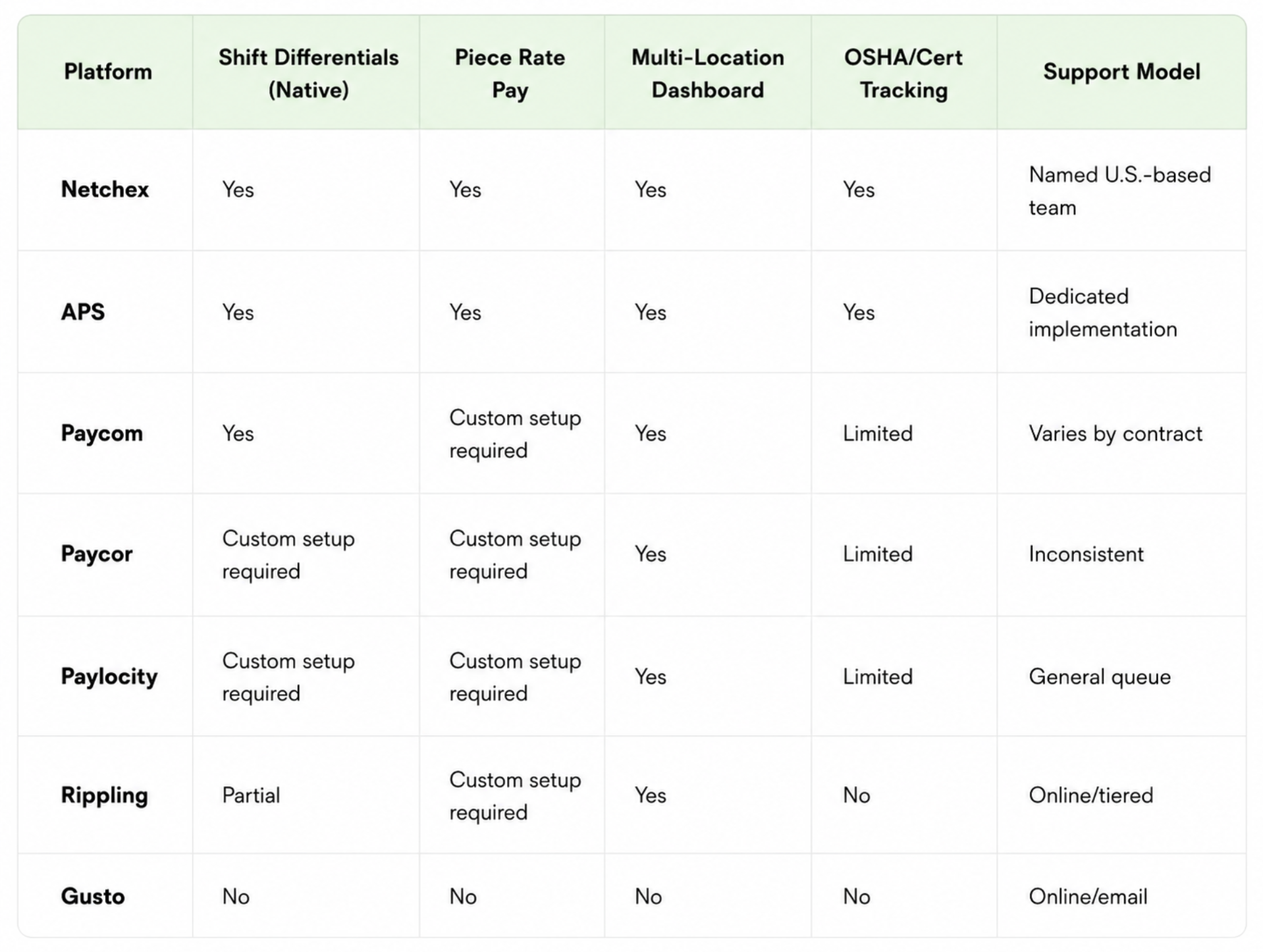
Netchex is the only platform on this list where shift differentials, multiple pay rates, and piece rate pay are native to the payroll engine. Not a workaround. Not a configuration that breaks when your account manager changes. They calculate automatically, for every worker, every pay period.
Time capture covers everything a plant floor actually uses: biometric, badge, kiosk, geofencing, mobile, and auto punch, all feeding directly into payroll without a bridge file. Schedules give real-time visibility into attendance and lateness, tied automatically to your violation policies so managers aren't making compliance calls on the fly. OneScreen Payroll gives you a complete picture of payroll readiness before you submit, across every facility at once.
Compliance is built into how the system runs, not something your HR team has to remember to check. Certifications, safety training completions, and license renewals are tracked with automated expiration alerts. ACA, wage and hour, I-9, and multi-state requirements run with full audit trails. For multilingual plant-floor workforces, AskHR answers employee questions in any language at any hour without routing through your HR team.
Here's what actually separates Netchex from the rest. When an employee works nights Monday through Wednesday and days Thursday and Friday at two different rates, Netchex calculates the shift differential, the blended regular rate, and the overtime correctly without someone manually reviewing the output. That's not a feature. That's the baseline your operation needs. Netchex holds a 98% customer satisfaction rating on G2 and is ranked #1 for customer service.
2. APS (Automatic Payroll Systems)
APS has real manufacturing depth. Shift differentials, multiple job codes, and variable pay are all natively supported. The Dimensions feature gives plant managers detailed visibility into labor costs by department, EIN, and location. OSHA incident tracking and a built-in LMS for safety training and certification renewals come standard, not as add-ons.
Implementation is structured, with dedicated project management and parallel payroll runs before go-live, which matters when you can't afford a botched cutover mid-quarter.
Where it starts to show limits: the mobile app has weak reviews (3.8/5 on Google Play), custom reports require piecing together multiple views that can't be merged into a single output, and there's nothing equivalent to Netchex's AskHR for a multilingual plant-floor workforce. It's a strong mid-market option if you don't need enterprise complexity, but the gaps show up when your workforce gets more complicated.
3. Paycom
Paycom's core advantage is its architecture. All HR, payroll, time, benefits, and talent data live in one database, so there's no reconciliation between platforms and no re-entry. Its Beti feature has employees review and approve their own pay before submission, which catches errors before funds move rather than after. Shift differentials flow natively into payroll and proximity-based time tracking handles plant-floor clock-ins.
The real gaps for manufacturing: piece rate pay and complex multi-rate configurations require custom setup and aren't supported out of the box. Support quality varies depending on the size of your contract. No native third-party ERP integrations means your operations and inventory systems stay in a separate silo, and someone is bridging that gap manually.
4. Paycor
Paycor has a clean interface and it handles the basics of multi-location management reasonably well. It connects with Indeed and has an AI assistant for routine HR tasks, which is fine if your pay structure is relatively simple.
The honest issue for manufacturing operators is that the things that make manufacturing payroll hard, shift differential rates, piecework, multi-rate configurations, all require custom setup in Paycor. Timekeeping and scheduling aren't bundled either; they're separate modules you add on. G2 reviewers have consistently flagged customer support as a weakness, and Trustpilot has documented failed implementations and billing disputes after cancellation requests. If you're running a complex operation and need a platform that handles it without a lot of handholding, this probably isn't it.
5. Paylocity
Paylocity's strongest argument is its integration breadth. Over 350 native integrations and a solid compliance dashboard make it genuinely useful for manufacturers running complex tech stacks where payroll needs to connect to ERP, WMS, or other operational tools.
The documented risks are specific and worth taking seriously. Incorrect W-2s, federal tax withholding errors, and implementation teams that missed YTD data transfers are all on record in Trustpilot and Gartner Peer Insights reviews. One Gartner reviewer was set up with multiple pay rates and was never told about the weighted averaging requirement for overtime, leaving them with three years of retroactive FLSA exposure. Piece rate pay and shift differentials still require custom configuration. If you have a dedicated HR team that can closely manage configuration and compliance, Paylocity is worth evaluating. If you don't, the risk is real.
6. Rippling
Rippling connects HR, payroll, and IT in one platform, so onboarding a new employee can simultaneously set up payroll, provision equipment, and grant system access. For manufacturing operations where HR and IT are tightly linked, that's genuinely useful. Multi-state payroll compliance is automated, and the workflow automation is flexible enough for a range of use cases.
The manufacturing-specific gaps are real though. Shift differential handling isn't where it needs to be for a complex multi-rate plant environment. Piece rate pay requires custom configuration. Modules add up in cost quickly, and implementation isn't simple for teams without dedicated HR tech resources. It's a better fit for tech-forward manufacturers with a more uniform pay structure than for a plant running three shifts with six different pay rates.
7. Gusto
Gusto is clean, setup is fast, and unlimited payroll runs are included across all plans. Automated tax filing covers all 50 states. For a single-site operation under 50 employees with a simple, uniform pay structure, it does the job without a lot of overhead.
The ceiling shows up quickly once manufacturing complexity enters the picture. Shift differentials, multiple pay rates, and piece rate pay aren't natively supported. A G2 reviewer managing over 700 employees documented payroll timing out and an inability to accommodate multiple pay rates at all. Multi-state and multi-location compliance isn't a core capability. Gusto is a good tool for the operation it was designed for, which isn't a plant running shift-based production workers across multiple facilities.
Quick Comparison Table
Get Payroll Right the First Time
Choosing payroll software for manufacturing is a labor cost decision, not an IT one. The right platform catches overtime errors before they become DOL penalties, tracks certifications before they lapse, and gives your HR team visibility across every facility instead of a different spreadsheet per shift. Most platforms on this list can process a paycheck. Not all of them can handle rotating shifts, piece rate workers, and multi-state compliance without someone manually stitching it together every pay period.
Visit netchex.com to see how it works for your operation.
Frequently Asked Questions
1. What is the best payroll software for manufacturing companies?
For multi-location manufacturers with complex pay structures, Netchex is the top pick. It natively handles shift differentials, piece rate pay, and OSHA certification tracking without custom setup. Gusto works for small single-site operations with simple, uniform pay structures.
2. What makes payroll for manufacturing different from standard payroll?
Shift differentials, multiple hourly rates, piece rate pay, overtime across rotating schedules, OSHA compliance tracking, and often a multilingual hourly workforce spread across multiple locations. Most general-purpose platforms weren't built for any of those requirements.
3. Does payroll software handle shift differentials automatically?
Depends on the platform. Netchex and APS calculate shift differentials natively. Paycom, Paycor, and Paylocity require custom configuration, which creates risk when account managers change or pay structures are updated.
4. How do I avoid FLSA violations in manufacturing payroll?
Use a platform that automatically includes shift differentials and piece rate bonuses in the regular rate of pay for overtime calculations. One documented Gartner Peer Insights case involved a vendor configuring multiple pay rates without disclosing the weighted averaging requirement for overtime, creating three years of retroactive liability.
5. What should multi-location manufacturing operators look for in payroll software?
Multi-facility payroll visibility in one dashboard, native support for multiple pay rates and shift structures, automated multi-state tax filing, OSHA and certification tracking, and a support team that understands how manufacturing payroll actually works. Confirm all of that before you sign, not after.