
Hotel management companies operate differently than property owners. You manage 10, 20, sometimes 50+ properties for different ownership groups. Each property has its own culture and requirements. You're hiring at scale but with local autonomy.
Your hiring challenge is coordination without micromanagement. Corporate consistency without losing property-level flexibility. Your Denver property and your Miami property need different hiring approaches, but they need to follow the same standards.
You're also competing for talent across multiple markets. Your Denver property competes with other Denver hotels. Your Miami property competes with Miami hotels. You need hiring that wins in each local market while maintaining corporate standards.
Hospitality turnover's 70% annually, and management companies see this pressure across all properties. One bad hire at one property reflects on your entire company. Your reputation is your asset. You can't afford bad hiring.
The hiring challenge is scale and coordination. You need one system that powers hiring across dozens of properties without becoming so complex that local managers can't use it. You need visibility without dictating.
6 Best Hiring Software for Hotel Management Companies in 2026
1. HigherMe
Management companies face a unique constraint: you manage 10-50+ properties for different ownership groups, often under different brand guidelines. You need hiring coordination without crushing local autonomy.
HigherMe's multi-property dashboard gives corporate visibility without eliminating local control. Corporate sees all hiring across properties. GMs see their property. Neither overrides the other. Standardized templates with customization solve the balance problem. Corporate creates "Front Desk Agent" once. Every property uses that template. But each property adds location-specific questions, what matters in downtown market vs. resort location.
Staff transfer tracking maintains employee history across locations, enabling succession planning and career progression visibility. Identify top performers across properties. Support career movement. Reduce external hiring by promoting internally. Retention analytics provide turnover data by property, so you identify high-performing locations and replicate their practices across the portfolio.
Interview automation (scheduling, reminders) reduces no-shows by 67%. When managing 20+ properties simultaneously, every operational efficiency matters. Paperless onboarding syncs across corporate and property systems. People hired Monday are payroll-ready Tuesday. No delays in coordination between management company and property operations. Payroll integration with ADP, Paychex, and Netchex enables automatic synchronization across all locations without manual reconciliation.
HigherMe won G2's Best Support badge, critical for multi-property operational stability.
Best for: Hotel management companies operating multiple properties while balancing corporate standards with local market autonomy.
2. Fountain
Fountain processes high-volume applications through video screening. For management companies with high application volume across all properties, this helps triage.
Candidates answer video questions. AI scores them. Your hiring teams watch top candidates. For coordinating screening across multiple locations, video creates a consistent standard.
The limitation is that Fountain doesn't handle multi-property coordination well. You're still managing each property separately. Corporate visibility is limited.
Best for: High-volume properties needing consistent screening standards.
3. TalentReef
TalentReef is simple, but it doesn't handle multi-property coordination. Your 15 properties each use TalentReef separately. You've got 15 separate hiring processes instead of coordinated hiring.
Candidate data doesn't share across properties. Corporate visibility is minimal.
Best for: Individual properties. Not management companies.
4. Harri
Harri's built for large hotel chains with multi-property hiring. It handles coordination well. Implementation and cost are high, but multi-property coordination is comprehensive.
The limitation is implementation takes 8-12 weeks. Management companies often need to hire faster. And cost is enterprise-level, which might be high for management companies with tight margins across multiple properties.
Best for: Very large management companies with long planning horizons and dedicated IT infrastructure.
5. iCIMS
iCIMS handles enterprise multi-property hiring. It's comprehensive and offers visibility across properties.
But implementation takes months. Training is extensive. Cost is enterprise-level. For management companies, this might be overkill.
Best for: Very large management companies with enterprise infrastructure.
6. Kronos Workforce Central
Kronos dominates scheduling for multi-property operations. Many management companies use it. Hiring integration makes sense if you're already in Kronos.
But Kronos' hiring tools are basic. You're getting coordination through Kronos infrastructure, not because the hiring product is great. And if you're not already using Kronos, the cost to implement just for hiring is hard to justify.
Best for: Management companies already running Kronos for scheduling.
Comparison Quick Reference
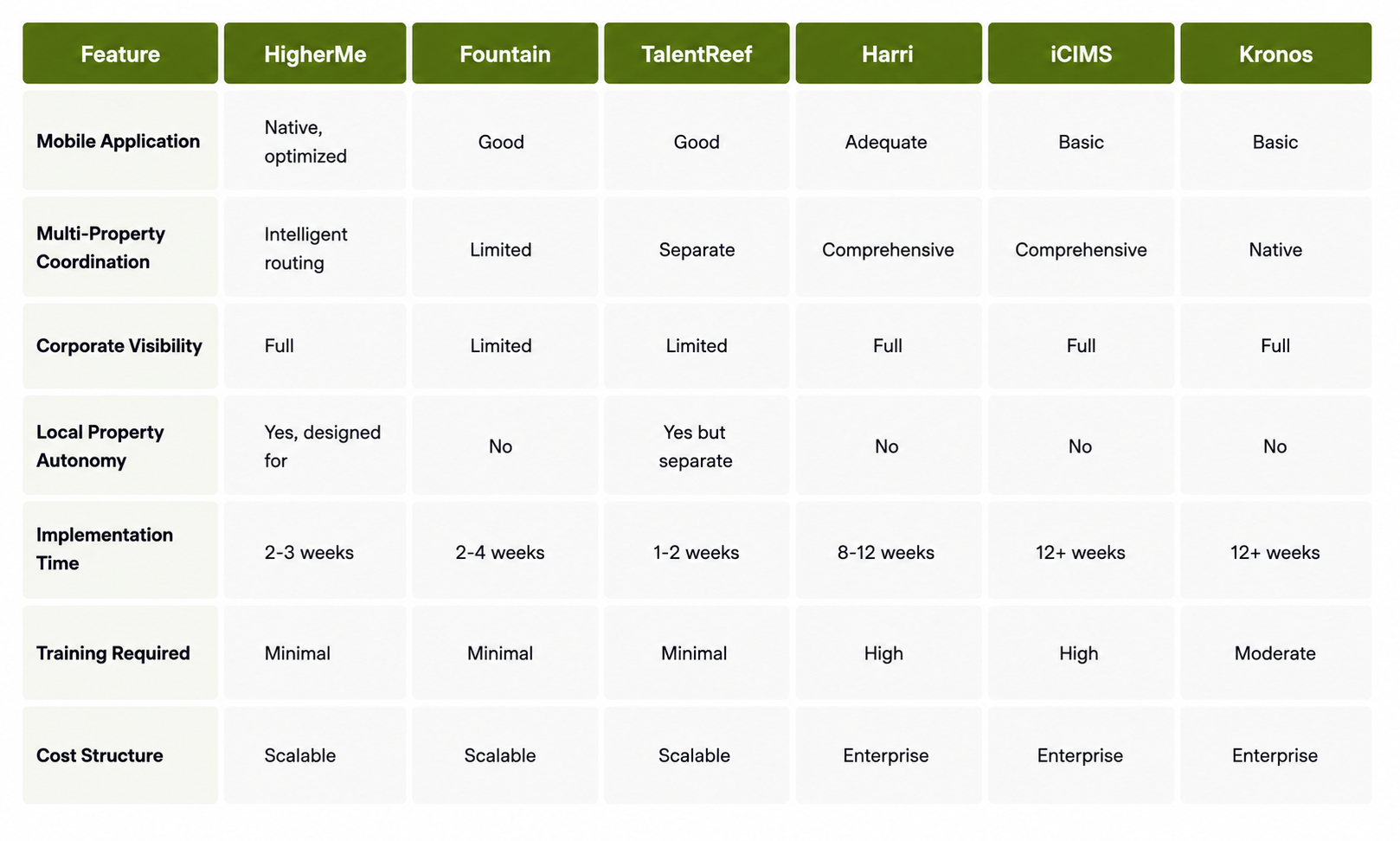
Coordinating Hiring Across Properties
Management companies win on efficiency and consistency. You need hiring that works across multiple properties without becoming too complex for local managers. You need corporate visibility without local resentment. That's the balance.
HigherMe's the only platform designed specifically for this. Multi-property coordination happens automatically. Each property manages their hiring. Corporate sees across all properties. You get consistency without dictating to local managers.
For management companies, that's the competitive advantage. Visit higherme.com to know more.
FAQ
Q1: How Do We Route Candidates to the Right Properties?
HigherMe routes candidates automatically based on location preference and property need. A candidate in Denver gets routed to Denver properties. A candidate willing to relocate gets options across all properties. Routing is intelligent and automatic.
Q2: How Do We Maintain Hiring Standards Across All Properties?
HigherMe's process is consistent across all properties. Same application. Same screening. Same sourcing. Each property uses the same system. Standards are built in.
Q3: How Much Visibility Does Corporate Get?
Full visibility. Corporate sees all positions, all candidates, all hiring across all properties. You can track time-to-fill by property, candidate quality across locations, hiring trends. Local managers don't see other properties, but corporate sees everything.
Q4: How Fast Can We Hire Across 20 Properties Simultaneously?
12-14 days. When you post positions across all 20 properties, HigherMe routes candidates to each. Your hiring across all properties happens in parallel. You're not waiting for sequential hiring. You're coordinating simultaneous hiring.
Q5: How Does HigherMe Compare to Harri for Management Companies?
Harri's built for enterprise chains planning hiring months in advance. HigherMe's built for management companies needing faster, more flexible coordination. If you have 5-30 properties, HigherMe wins on speed and flexibility. If you have 50+ properties and dedicated IT infrastructure, Harri might fit.