.png)
Running payroll at a dialysis center is not like running payroll anywhere else. You've got RNs, patient care technicians, biomedical techs, dietitians, and social workers, all under one roof, all with different pay rates, certification requirements, and renewal cycles. And you're doing it across three treatment shifts a day, six or seven days a week, with CMS watching.
As of 2024, there are more than 7,500 dialysis centers in the U.S. treating over 500,000 patients. The workforce behind that care is under constant pressure. In a recent national survey of PCT staff, only about half intended to continue working as patient care technicians. High turnover plus complex pay structures plus CMS compliance obligations equals a payroll environment that punishes generic software.
Why Most Payroll Software Fails Dialysis Centers
Generic payroll tools are built around simple assumptions: one pay rate per employee, standard hours, straightforward tax filings. Dialysis centers break all of those at once.
Every PCT working a treatment station must hold an active BONENT or NNCC certification. RNs need current state licensure. Biomedical techs, dietitians, and social workers each carry their own credentials with different renewal cycles. CMS ESRD Conditions for Coverage require this documentation to be audit-ready at any time. Most platforms don't track any of it natively. You're managing credential expiration in a spreadsheet somewhere, hoping nothing slips.
The pay complexity problem is equally real. You're calculating RN shift differentials, PCT hourly rates, overtime across three-treatment-per-day shift blocks, and biomedical technician pay, all in the same payroll run. A platform that doesn't support multiple pay rates, shift differentials, or configurable overtime rules forces manual workarounds. Manual workarounds create errors. In healthcare payroll, errors don't just create compliance problems. They affect whether staff show up.
The 6 Best Payroll Software Platforms for Dialysis Centers
1. Netchex
Netchex is built for organizations where workforce complexity is the norm, not the exception. For dialysis centers, that means native support for every pay type across your clinical and technical workforce, credential and license tracking with automated expiration alerts, and CMS ESRD staffing documentation that stays audit-ready without manual compilation.
PCT certification tracking covers BONENT and NNCC credentials, RN licenses, biomedical technician qualifications, and RD licensure. When a credential is approaching expiration, automated alerts go out before anything lapses. Documentation is stored and retrievable the moment a CMS surveyor walks in.
Payroll handles RN shift differentials, PCT hourly rates, and multi-shift overtime natively. OneScreen Payroll surfaces discrepancies and anomalies across all your locations before payroll is submitted, so errors get caught before money moves, not after.
For retention, Netchex includes Earned Wage Access, which gives PCTs and RNs on-demand access to wages already earned before payday. In a labor market where your staff can take their certification to a competing center across town, financial wellness tools are a real retention lever. The built-in LMS covers 2,000-plus courses including HIPAA, infection control, OSHA, and renal care training.
Here's what actually separates Netchex from the rest: dialysis center payroll is a compliance function as much as a financial one. The right software doesn't just move money accurately. It keeps credentials current, flags errors before they become CMS findings, and supports the kind of staff retention that keeps treatment chairs covered. Netchex is built closest to that standard for mid-market dialysis operators.
2. APS (Automatic Payroll Systems)
APS handles multiple job codes, variable pay rates, and shift differentials natively. Its built-in LMS covers safety training and certification renewal tracking, and the Dimensions feature gives operations managers visibility into labor costs by department and location.
Where it falls short for dialysis specifically: APS doesn't have a named ESRD vertical, so CMS documentation readiness and PCT-specific certification types aren't pre-built the way they are in Netchex. Credential tracking exists but requires more manual setup to cover the specific credential types your center deals with. If you're prepared to do that configuration work, APS is a solid mid-market option. If you need it to run correctly out of the box, it'll take longer to get there.
3. Paycom
Paycom's single-database architecture means HR, payroll, time, benefits, and talent data all come from one source. Beti has employees review and approve their own pay before submission, which is a genuine error-prevention tool for high-headcount clinical operations. The compliance toolset covers ACA, FLSA, FMLA, and OSHA reporting.
The dialysis-specific shortcomings are consistent. Credential tracking isn't built around renal care compliance requirements. CMS ESRD reporting isn't a native feature. The interface has a documented learning curve, and support quality varies by contract size. If you need PCT and RN credentials tracked with automated expiration alerts without significant custom configuration, Paycom isn't the fastest path there.
4. Paychex Flex
Paychex Flex has real strengths, particularly for dialysis operators that don't have in-house HR professionals. The PEO service that delegates HR administration to an expert team takes real burden off small HR functions. Payroll, tax filing, and benefits management are reliably handled.
The dialysis-specific shortcomings are consistent with what you see in other clinical contexts. Credential tracking is limited and not built around renal care compliance requirements. CMS ESRD reporting isn't included. Support quality is the most frequently cited complaint on review platforms, with users describing difficulty reaching someone with authority to resolve complex issues. For a dialysis operator where a payroll problem affects whether staff show up for a treatment shift, that matters.
5. Paylocity
Paylocity's 350-plus integrations and compliance dashboard have real value for dialysis operators running complex tech stacks. For centers where HR, scheduling, and payroll need to connect across multiple systems, that integration depth is worth evaluating.
The documented risks carry over from other clinical contexts. Incorrect W-2s and implementation teams that missed YTD data are on record. No native BONENT/NNCC credential tracking, no CMS ESRD documentation support, and shift differentials and multi-rate configurations require custom setup. For an environment where a credential lapse creates both a patient care and a CMS compliance problem on the same day, manual tracking is a real liability.
6. Gusto
Gusto is clean, affordable, and easy to use. For a very small independent center with fewer than 30 employees and a straightforward pay structure, it handles the basics without much overhead.
The limits show up immediately in a dialysis context. No credential or license tracking. No shift differential engine. No Earned Wage Access. No CMS ESRD compliance reporting. It was built for salaried-dominant, simple businesses, and most dialysis centers aren't that.
Quick Comparison Table
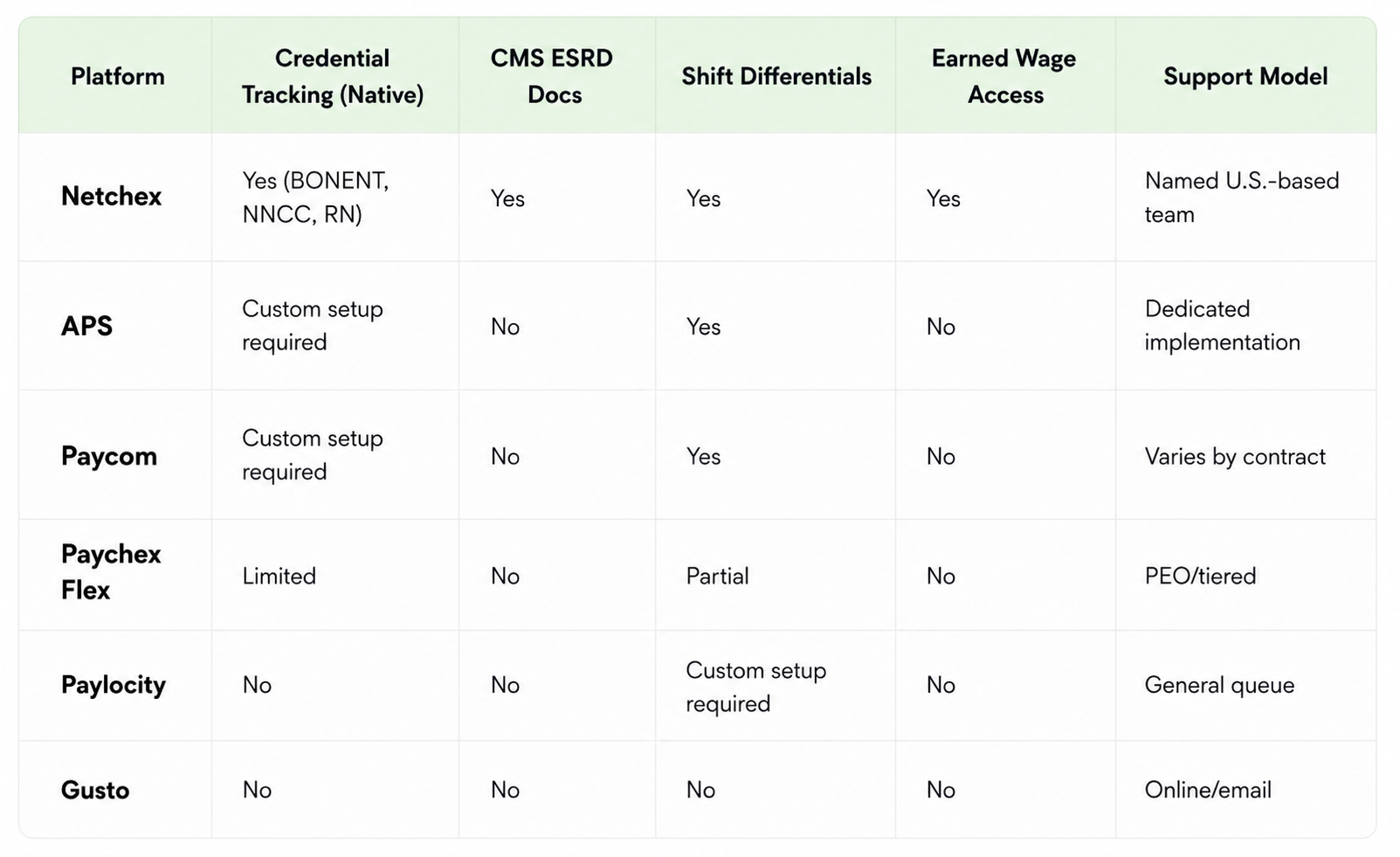
The Right Software Keeps the Treatment Chairs Covered
For most mid-market dialysis centers, Netchex is the platform built closest to what this environment actually needs. The others on this list have strengths worth knowing, but most of them ask your team to carry compliance obligations the software should be handling.
Visit netchex.com to see how Netchex supports dialysis center operations.
Frequently Asked Questions
1. What is the best payroll software for dialysis centers?
Netchex is the strongest option for most dialysis centers. It handles the full range of clinical pay structures natively, tracks PCT and RN credentials with automated alerts, includes CMS ESRD documentation support, and offers Earned Wage Access as a retention tool. For very small centers with simple payroll needs, Gusto is serviceable at a lower cost but has no clinical compliance features.
2. Does payroll software track PCT certifications and nursing licenses?
Most general payroll platforms don't. Netchex does. It tracks BONENT and NNCC PCT certifications, RN state licenses, biomedical technician qualifications, and RD licensure, each with expiration dates and automated renewal reminders.
3. Can payroll software help reduce staff turnover at dialysis centers?
Indirectly, yes. Earned Wage Access gives PCTs and RNs on-demand access to wages already earned before payday, which is a real differentiator when competing centers are actively recruiting the same credentialed staff. Consistent accurate paychecks and mobile self-service also reduce the day-to-day friction that pushes people to look elsewhere.
4. What should I ask a payroll vendor before buying for a dialysis center?
Three questions worth asking every vendor: Is credential tracking native or does it require custom configuration? Can you demonstrate how shift differentials and three-treatment-per-day overtime are calculated without manual steps? What does ongoing support look like after implementation, and who specifically handles healthcare clients?
5. How does payroll software help with CMS ESRD Conditions for Coverage compliance?
Platforms like Netchex store PCT BONENT/NNCC certifications, RN licenses, and other required credentials with expiration tracking and automated renewal alerts. Documentation is retrievable on demand for CMS surveys. Platforms that don't support this natively require manual tracking, which introduces gaps and audit risk every renewal cycle.